AI in Clinical Practice & Responsible Innovation: Anyi Li on Bridging Technology and Patient Care
April 29, 2026
Episode Overview
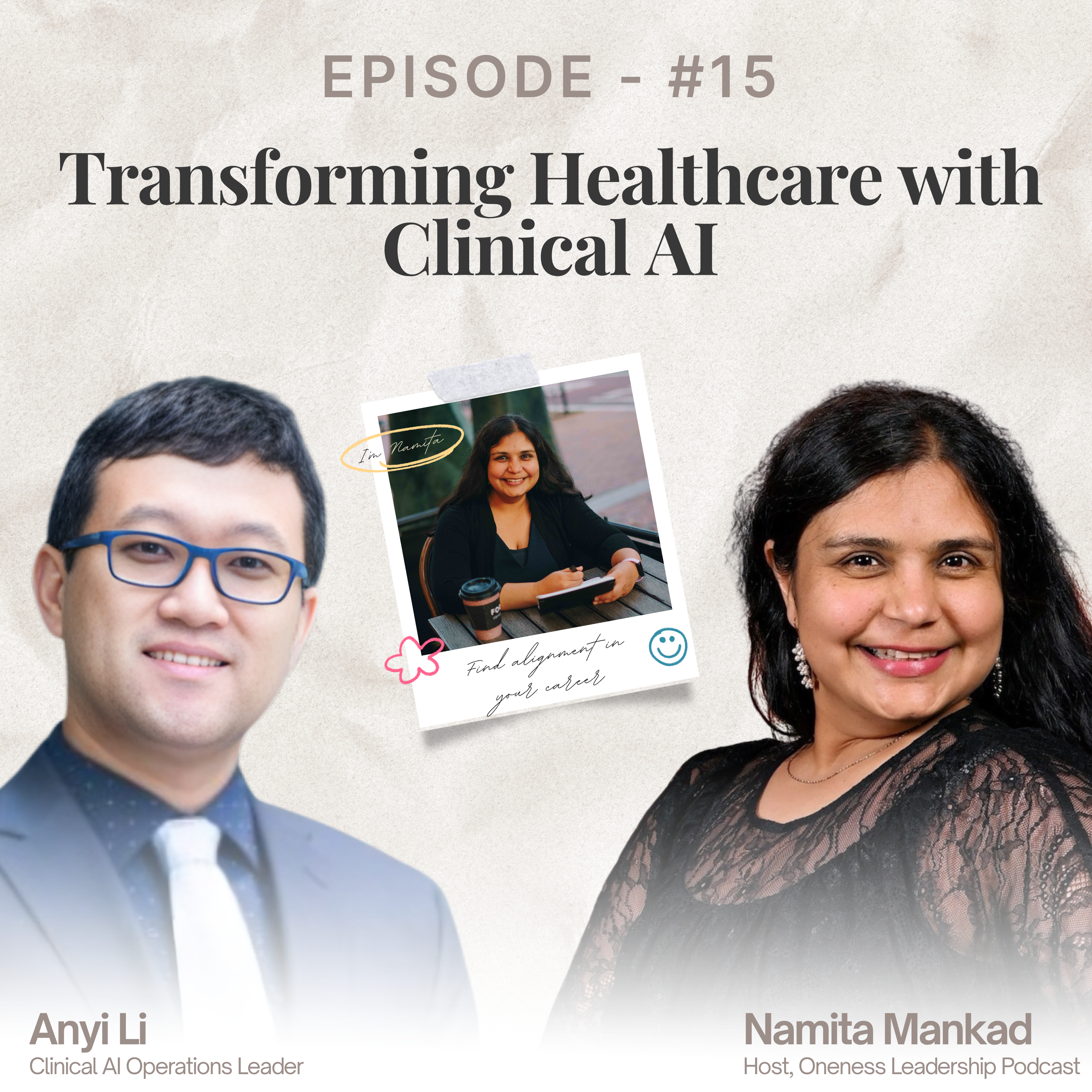
In this episode of the Oneness Leadership Podcast, Namita sits down with Anyi Li, Attending Physicist and Chief of Computer Service at Memorial Sloan Kettering Cancer Center, where she leads the integration of AI into real-world clinical workflows.
With deep expertise at the intersection of physics, healthcare, and advanced technology, Anyi works on translating AI from concept into practical, patient-centered applications within one of the world’s leading cancer institutions.
But what makes this conversation especially powerful is not just the technology.
It’s the reality of applying it.
Because in healthcare, innovation is not just about what is possible, it’s about what is safe, effective, and meaningful in real clinical environments.
This episode explores a deeper question:
👉 How do we move AI from theory into real-world clinical impact without losing sight of patient care?
From integrating AI into daily workflows to navigating complexity, risk, and responsibility, Anyi shares how leaders can bring technology into healthcare in a way that truly improves outcomes.
About the Guest
Anyi Li is an Attending Physicist and Chief of Computer Service at Memorial Sloan Kettering Cancer Center.
She leads initiatives focused on integrating artificial intelligence into clinical workflows, ensuring that advanced technologies are not only innovative but also practical, reliable, and aligned with patient care.
Her work bridges the gap between research and real-world application, helping translate complex AI models into tools that clinicians can trust and use effectively.
Anyi brings a unique perspective that combines technical expertise, clinical understanding, and leadership in high-stakes healthcare environments.
Connect with Anyi
LinkedIn: linkedin.com/in/anyili
Website: https://www.mskcc.org/profile/anyi-li
Show Notes
In this conversation, Namita sits down with Anyi Li to explore how artificial intelligence is being integrated into real-world clinical practice.
Anyi shares how the challenge is not just building advanced AI systems, but ensuring they work reliably within the complexity of healthcare environments.
A key theme in this episode is the gap between innovation and implementation.
While AI is advancing rapidly, translating those advancements into clinical workflows requires careful consideration of safety, usability, and trust. Anyi explains how leaders must bridge this gap by aligning technology with real-world needs.
The conversation also explores the role of AI in improving patient care.
From enhancing decision-making to supporting clinicians, AI has the potential to transform outcomes, but only when implemented thoughtfully and responsibly.
Another important aspect of the discussion is risk and accountability.
In healthcare, decisions carry significant consequences. Anyi highlights the importance of validation, governance, and continuous monitoring when deploying AI systems in clinical settings.
Beyond technology, the episode dives into leadership.
Anyi reflects on what it takes to lead at the intersection of innovation and patient care, balancing speed with safety, and ambition with responsibility.
This episode offers a powerful perspective on how leaders can integrate cutting-edge technology into critical systems while maintaining trust, precision, and human-centered care.
Topics Discussed in This Episode
- Integrating AI into real-world clinical workflows
- Bridging the gap between AI research and clinical application
- The role of AI in improving patient outcomes
- Challenges of implementing AI in healthcare systems
- Balancing innovation with safety and reliability
- Governance, validation, and accountability in AI
- Building trust in AI-driven clinical tools
- Supporting clinicians with technology
- Leadership in high-stakes healthcare environments
- Translating complex systems into practical solutions
- The future of AI in medicine and patient care
Q&A From the Conversation
What is the biggest challenge in applying AI in healthcare?
The biggest challenge is not building the technology, but integrating it into real clinical workflows. AI must be reliable, usable, and aligned with how clinicians actually work.
How can AI improve patient care?
AI can enhance decision-making, support clinicians, and improve efficiency. However, its impact depends on how well it is implemented and trusted within the system.
Why is trust so important in clinical AI?
Because healthcare decisions directly affect patient outcomes. Clinicians need to trust that AI systems are accurate, validated, and safe to use.
What role does leadership play in integrating AI?
Leadership is critical in balancing innovation with responsibility. Leaders must ensure that new technologies are implemented thoughtfully, with clear accountability and alignment to patient care.
How do you balance speed and safety in innovation?
By prioritizing validation and real-world testing. In healthcare, moving fast cannot come at the expense of safety or reliability.
Key Takeaways
- AI must be integrated thoughtfully into real clinical workflows
- Innovation without implementation does not create impact
- Trust and validation are critical in healthcare AI
- Patient outcomes must remain at the center of technology decisions
- Leadership is essential in balancing speed with responsibility
- AI can enhance, but not replace, clinical judgment
- Practical application matters more than theoretical capability
- Governance and accountability are key to successful adoption
- The future of healthcare lies in responsible, human-centered innovation
Get the monthly newsletter designed by Namita for tech leaders and ambitious founders who are ready to lead with clarity, trust their intuition, and turn challenges into growth. Elevate your leadership, career, and impact.
Get the Monthly Newsletter
