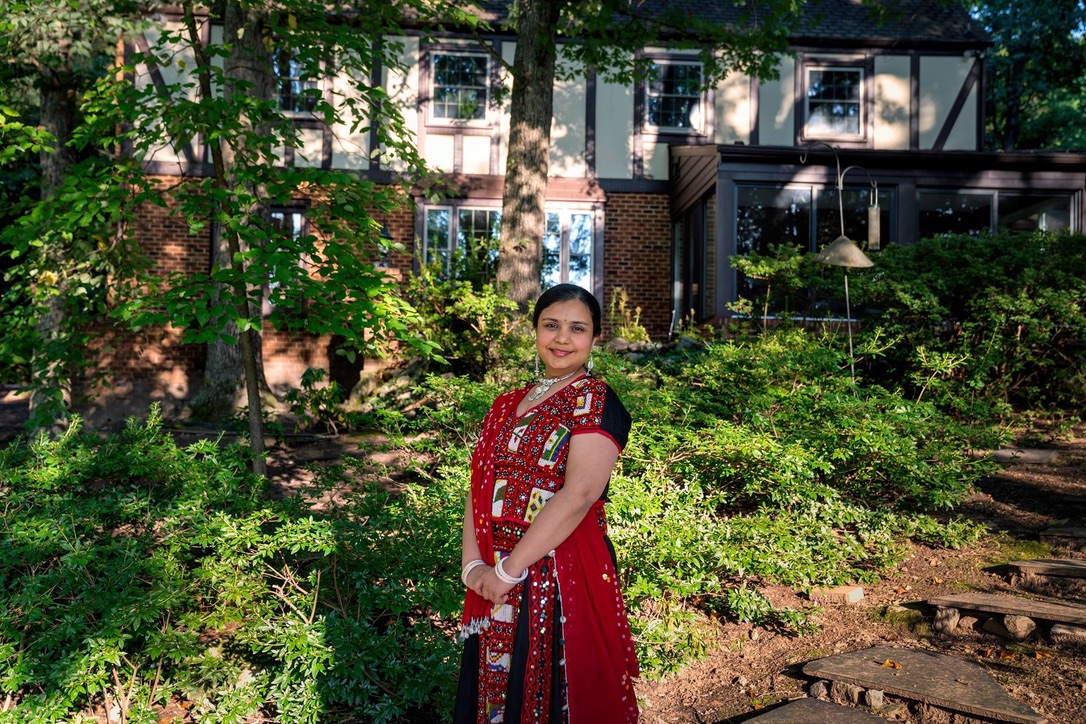

How a multi-passionate child learned to fold her wings
By the time I reached tenth standard, I already knew I could become many things.
As a child, I participated in almost every activity available to me. If there was a cultural program, dance, singing opportunity, essay contest, drawing activity, or elocution competition, I wanted to take part. I was always busy growing, whether I was standing before an audience or sitting quietly with a book.
Dance held a special place in my life. I led some performances at school, and outside school, I participated in Raas Garba during Navratri, the nine-night festival celebrated across Gujarat. I was regularly chosen as part of the first pair, leading the dancers as we presented the performance to the audience.
Navratri required commitment. We prepared for one or two months before the festival. Then, for nine consecutive nights, we danced for two or three hours every evening. I loved the preparation, the rhythm, the coordinated movement, and the energy of performing before an audience.
I also completed my first year of classical dance. I sang well enough that my music teacher encouraged me to enter competitions. He heard something in my voice that deserved to be developed.
Drawing opened another form of expression. I wanted to take advanced drawing examinations and discover how far that ability could go.
Elocution came naturally to me too. I performed well in competitions and represented my school at interschool events. Long before I became a professional or a leader, I was already learning how to stand before an audience, enter the meaning of a passage, and hold a room through my voice.
Sports held less appeal. I participated enough to meet the school requirements and earn good grades. I even placed third in a running race, which felt perfectly sufficient. I had completed the task and could return to the activities that genuinely energized me.
My attention moved naturally toward expression. I wanted to dance, sing, draw, write, read, speak, and perform.
I was a scholar, an artist, a speaker, and an eager participant in life.
The Languages That Raised Me
Language was one of my most natural gifts.
Gujarati was my native language, and my Gujarati teacher loved my writing. I won essay competitions and discovered early that I enjoyed shaping thoughts through words.
I completed advanced examinations in Hindi and loved singing dohas and songs in both Hindi and Gujarati. Sanskrit gave me another form of musical expression. I learned and sang Sanskrit slokas and won competitions through them.
English became another literary home. In my tenth-standard board examination, I received the highest score in English. Board examinations carried enormous importance in India. The results marked a major academic threshold and helped determine the educational path that followed.
My English teacher was filled with joy when she saw my score. She told me I was her best student.
Her happiness stayed with me because she saw something deeper than a mark on an examination. She recognized my relationship with language and literature at the very moment my future was beginning to take shape.
I read constantly and across languages.
Jules Verne fascinated me through the vastness of his imagination. His stories showed me how far the mind could travel beyond the world directly in front of us.
Kanhaiyalal Munshi drew me toward diplomacy, leadership, loyalty, power, and the complexity of human ambition.
Jhaverchand Meghani connected me with Gujarati folk songs and stories. His work carried the voices of ordinary people, inherited memory, courage, sorrow, and the spirit of the land.
Narsinh Mehta reached me through his ability to express profound spirituality in simple words. He showed me that a song, a familiar image, or a few accessible lines could carry devotion, compassion, and higher truth directly into the heart.
Reading allowed me to inhabit many worlds while living inside one.
The writer in me was already present. Literature was teaching me how to observe people, recognize patterns, feel deeply, and find language for experiences I had yet to live.
The Freedom to Grow
With so many interests, I valued time alone.
That time was rarely empty. I was usually reading, practicing something, discovering a new interest, or following an idea that had captured my attention. I could remain absorbed for hours because growth felt natural to me. There was always another book to enter, another skill to explore, or another part of myself waiting to develop.
My mother would often remind me to come and spend time with the family. I could become so engaged in what I was learning or creating that I lost track of time.
Solitude lived beside a bubbly and highly social personality. I enjoyed meeting people, participating in gatherings, and building connections. I was often more social than the rest of my family. Even as a child, I seemed to understand the power of relationships and networks. At times, I wondered why my family maintained such a small circle of friends.
While our circle of friends stayed small, our family itself was huge. Someone was always visiting us or living with us, and the house was rarely quiet. Growing up inside that constant flow of relatives gave me the chance to observe people closely and understand relationship dynamics deeply, even at a young age.
I needed both worlds.
People gave me energy, stories, connection, and belonging. Time alone gave me the freedom to read, think, practice, imagine, and follow my many interests wherever they led.
My independence grew from that desire for space. A multi-passionate life required the freedom to direct my own attention. Long before independence became financial, it meant having room to continue becoming.
It began as the freedom to occupy my own mind.
“Study and Get a High-Paying Job”
Around eighth standard, after I placed second in the school, the direction of my future began to narrow.
In the India of my childhood, academic success opened the path toward science, engineering, professional respect, and financial stability. A serious student was expected to focus. Hobbies could remain at the edges as long as they never interfered with the path toward a dependable profession.
My father’s guidance was simple.
“Study and get a high-paying job.”
My parents shared a clear vision for my future. I would become educated, professionally successful, and financially independent.
My mother carried that vision through her own experience. She had been a scholar and came from a family where women were intelligent, educated, and deeply involved in raising children who were academically strong and culturally grounded. She had a sharp mind and a natural ability to teach.
Within the patriarchal society around her, much of that intellectual power remained contained within the home. Her intelligence served the family, while the world gave her fewer opportunities to build a professional identity and financial standing of her own.
She wanted her daughter’s intelligence to have a wider life.
My mother turned that intention into daily commitment. Through tenth standard, she personally taught me almost every subject. She explained concepts, checked my work, and stayed with me until I understood. Even during higher secondary school, when I attended tuition classes, I still went to her whenever I became stuck on a problem.
My academic success carried her intelligence, discipline, and constant presence within it.
My father focused on the profession that would transform that education into financial strength.
At the time, information technology was booming. People who went abroad were earning well, much of our extended family already lived in the United States, and our green card application had been filed. America was already part of our family’s future.
My father saw computer engineering as the strongest bridge between education, immigration, and financial security.
He wanted me to become a computer engineer.
I had always been strong in mathematics and science, so I possessed the academic ability to follow that path. Biology interested me most because it connected me with living beings. I was fascinated by life, the human body, and the intelligence within nature. Even within science, my attention moved toward what felt alive.
Computer engineering felt distant from my natural personality. I was energized by people, language, movement, stories, music, performance, and human connection. The black-and-white computer screens of that time held little appeal for me. Spending long hours with a machine felt disconnected from the way I experienced the world.
My father and I argued. We negotiated. Eventually, I gave in.
Destiny also had its say. Medical school might have offered a closer connection to living beings, but my score fell slightly short. Other possible routes, whether a creative path or an external medical examination, required additional time. Our immigration process was already moving, and time had become part of the decision.
I understood what the decision carried. I was the eldest daughter, and my family’s future rested heavily on the path I created. Computer engineering offered income, immigration possibilities, professional respect, and the ability to help the people I loved move forward.
So I entered a profession shaped by my parents’ shared vision and my own sense of responsibility.
As my academic focus intensified, the expressive parts of my life receded. The Raas Garba preparation and my place in the first pair ended. Classical dance stopped after the first year. The music competitions faded before I entered them. The advanced drawing examinations remained a possibility I had once imagined.
I learned how to succeed in the path chosen for me. I became capable, disciplined, and professionally strong.
Even there, my nature found its way toward people. I moved into leadership roles early in my career, drawn to teams, collaboration, and human connection. Leading let me feel alive inside a technical world, and my years working directly with machines remained few.
I immigrated to the United States. I earned an income, supported my family, managed my finances, and bought a home before marriage and before my husband even came to this country.
Independence had already become part of my identity. My parents had given me roots strong enough to stand on my own.
The narrow shape of the path taught me to fold my wings so I could fit inside it.
Later Kept Moving
At first, the pause felt temporary.
Study now. Dance later.
Build the career now. Sing later.
Become independent now. Explore everything else later.
Later kept moving.
Even after I became an engineer, immigration left little room for returning to the activities I loved. My time belonged to work, family responsibility, and the daily effort of building stability in a new country. Every hobby required money, time, and space, and I had none of those to spare. Creative exploration belonged to a level of freedom I had yet to reach.
Then marriage arrived and became the next responsibility, eventually the largest one.
I entered it already trained to place duty first. I knew how to work hard, carry more than my share, and organize my value around how much I could manage.
The artist inside me grew quieter.
Writing stayed closest to me, and even writing took its pause. During the immigration and marriage years, I had little time to write and even less time to think of writing. The writer waited quietly through it all, absorbing and holding the memories that would one day become language.
She returned once I separated, and she became the thread connecting the expressive child to the woman I would eventually reclaim.
How Did This Girl End Up There?
There is a question I have asked myself many times.
How did a girl who was so curious, expressive, social, capable, and independent end up in a marriage that made her life so small?
I had arrived in the United States, built a career, supported my family, managed my finances, and bought a home before my husband even came to this country. I knew how to earn, lead, solve problems, and survive.
I also knew how to adapt.
When a path was chosen for me, I learned to excel inside it. When my family needed me, I carried more. When my personal desires competed with responsibility, I folded them away and continued forward.
Over time, sacrifice became familiar. Endurance felt like strength. Carrying other people felt like love. My ability to adjust became one of the qualities I trusted most about myself.
Those qualities helped me build a career and create security for my family. Inside my marriage, they kept me working harder each time the relationship demanded more from me.
I entered marriage believing that love, effort, loyalty, and responsibility could build a life. When the relationship became painful, I responded with the skills that had carried me through every previous challenge. I adapted. I worked harder. I tried to understand. I accepted more responsibility. I searched for the solution within myself.
The marriage continued asking me to become smaller, and I had already spent years learning how to fold parts of myself for a future larger than my own immediate desires.
This time, the folding reached much deeper.
The dancer grew quiet. The singer disappeared. The woman who loved people and connection became increasingly isolated. The independent girl remained capable on the outside while her inner world contracted around the marriage.
That is how a woman who could stand on her own feet could still lose contact with her wings.
My financial independence eventually gave me the practical ability to leave.
Reclaiming the artist helped me understand why I had to.
Only after I walked away did I begin to see that the story of my marriage, the suppression of my creativity, and my complicated relationship with beauty were connected. Each carried the same central question:
How much of myself had I learned to surrender in order to preserve the life I had been told was right?
The Artist and the Beauty Were One
After leaving the marriage, I began tracing the disappearance of the woman I had once been.
For many years, I understood beauty, creativity, and marriage as separate parts of my life. Beauty belonged to childhood, to the ways girls were noticed, praised, and compared. Creativity belonged to the activities I set aside when achievement became the center of my future. Marriage belonged to adulthood and the life I had tried so hard to preserve.
Only later did I recognize the thread running through all three.
When I danced, I felt beautiful.
When I sang, I felt beautiful.
When I drew, I felt beautiful.
When I wrote, I felt beautiful.
The feeling came from expression. Beauty was the experience of life moving freely through me. It lived in concentration, imagination, rhythm, language, voice, and joy. I felt beautiful whenever my inner world had somewhere to go.
As my life narrowed, that natural feeling receded. Other people’s opinions grew louder in the space my own aliveness had once filled.
The suppressed artist and the unclaimed beauty were one wound with two names.
Expression was my beauty.
Folding my wings created the vacancy.
Opening My Wings Again
My reclamation began after my divorce through small acts of curiosity.
I started learning ballroom dancing. My adult body entered the studio carrying decades of responsibility. I had to learn where to place my feet, how to hear the rhythm, and how to allow movement to become pleasurable again.
With every step, my body remembered a language it had once known.
It could turn, glide, and take up space. It could enjoy being seen while remaining fully its own.
I explored the basics of singing and began asking which parts of my childhood still felt alive within me. This became a return to the fuller range of who I had always been.
My parents gave me the foundation of financial independence. That foundation helped me walk into a new life.
The artist gave me aliveness. She helped me recognize myself once I arrived there.
I carry both legacies.
I am an engineer who writes, a leader who dances, and a practical woman with an artist’s interior life. I am a daughter who honors her parents’ wisdom while allowing herself to expand beyond the world they knew.
The disciplined path taught me how to build a life.
The creative path is teaching me how to inhabit it fully.
Today, I often think about the young girl composing Gujarati essays, singing in several languages, leading Raas Garba, reading across cultures, and representing her school in elocution competitions.
She had no idea where life would take her, how far she would travel, or how deeply she would be tested.
She simply knew that words made her feel like herself.
They still do.
All along, my beauty lived inside my expression.
Perhaps that is where beauty begins for many of us. It begins where the inner life is allowed to move, create, speak, dance, and become visible.
The Question I Ask the Leaders I Coach
Many accomplished professionals carry a version of this story.
They earned degrees, built careers, supported families, and became the person everyone could depend upon. Their success reflects discipline, intelligence, and years of effort. Somewhere within that success, another part of them may still be asking for space.
A leader who feels strangely flat may be carrying the musician who stopped playing. An executive who feels disconnected from her own achievements may have spent years away from the activities that once made her feel most alive.
In my work as an executive leadership coach, I have learned that these waiting parts hold enormous energy. Every life experience shapes us and builds real strength. Our fullest leadership emerges when we receive everything our path gave us and unfold the wings we once learned to contain.
So I will leave you with two questions:
Which part of yourself did you fold away to become successful?
What becomes possible when you open your wings again?
If a part of you is ready to return, I would love to explore it with you. As an executive leadership coach, I work with leaders who are ready to bring their full selves into their work and their lives. Reach out through namitamankad.com.


Comments +