From Medicine to Entrepreneurship: Following Intuition, Building Innovation, and Creating Lasting Impact
June 12, 2026
Episode Overview
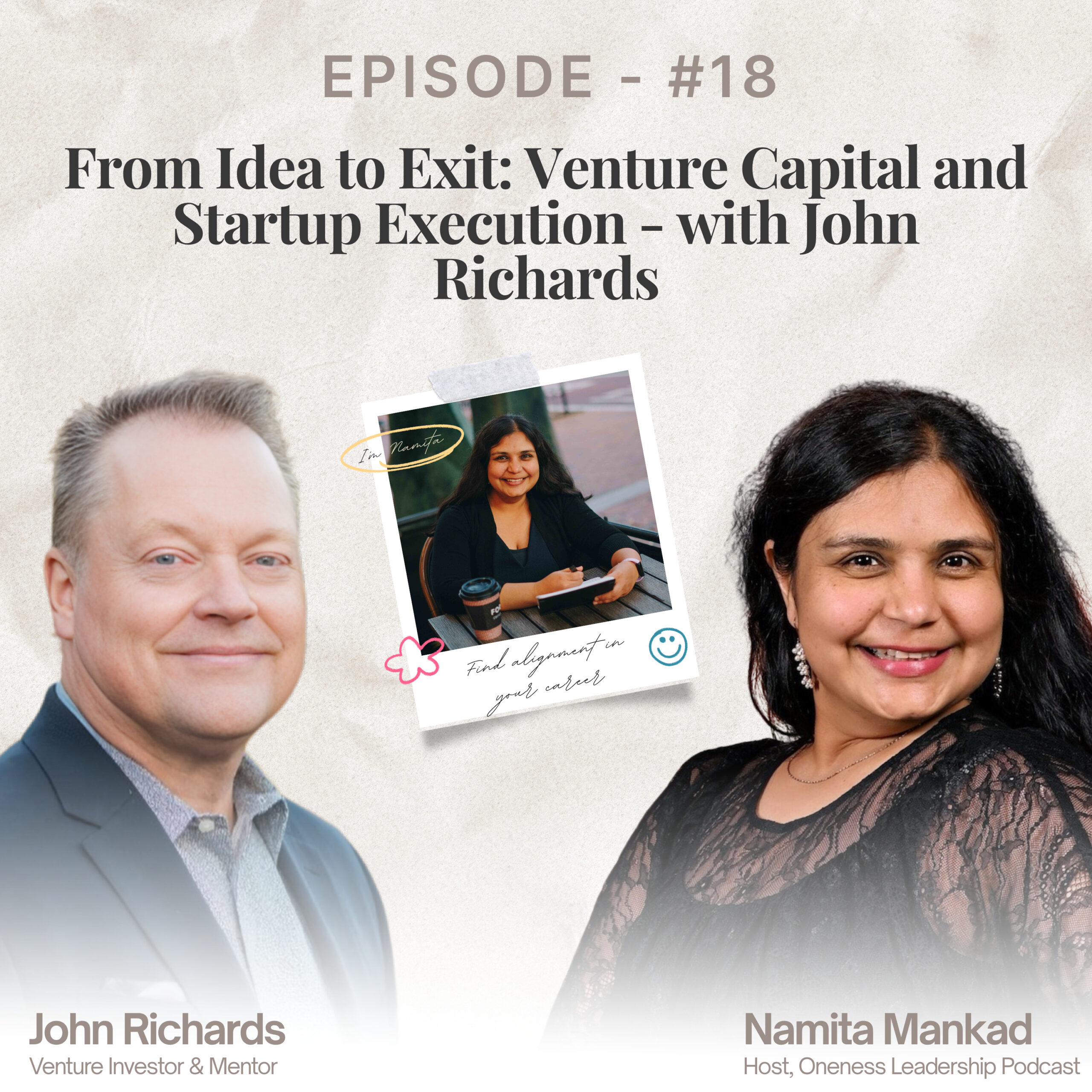
On this episode of the Oneness Leadership Podcast, Namita Mankad talks with John Richards, an entrepreneur, educator, investor and startup mentor who was accepted into medical school — and turned it down. That one decision led him to build a Yellow Pages company, help launch InfoSpace in the early internet era, bring Google Fiber to Provo, Utah, and spend two decades teaching entrepreneurship, most recently through Startup Ignition.
John shares how he learned to spot industry shifts early, why the Lean Startup method explained his own successes and failures, and what 43 years of marriage and partnership taught him about balance. The show is also known as the Wellness Leadership Podcast.
Key Takeaways
- Listen before the path locks in. John shadowed a surgeon, saw the life behind the title, and chose the future he and his wife actually wanted — before medical school decided it for him.
- Disruption is an opening. When AT&T was broken up, he chose the one unregulated, highly profitable line of business — Yellow Pages — and built it to 44 publications.
- Pivot when the evidence arrives. Told in 1994 that the internet would put him out of business in two years, he sold the print company, put Yellow Pages online first, and merged into what became InfoSpace.
- Validate before you build. Interview 20 or more target customers before spending money on a product; most startup failure is building on an untested assumption.
- Don’t hide your idea. Passion can’t be stolen. An idea nobody hears about gets no investors, no mentors and no momentum.
- Family balance is designed, not found. His wife’s two rules — live close to work, and be home from 6 to 8:30 for dinner and the children — held a 60-to-80-hour work life and a family together.
In John’s Words
“Curiosity is a big part of it, and also willingness to adapt.” — John Richards, on the secret behind a series of successful decisions
“Don’t rush out and go build the product and assume that you’re correct.” — on the biggest tip he gives entrepreneurs
“We need to use the scientific method, the most important thing humans have ever developed to find out truth, and apply it to entrepreneurship.” — on Lean Startup validation
“Most entrepreneurs, most investors don’t steal ideas, because most great ideas come from within a person, and they’ve experienced the pain or the problem.” — on the fear of idea theft
“An entrepreneur should work for a few years so hard like nobody else is willing to do, so they can live the rest of their life like very few people are able to do.” — a mentor’s words he lived by
“Grandchildren really are the reward for taking all the duties and responsibilities of parenthood.” — on family
Conversation Highlights… (Expand to read more)
Episode Chapters
- Leaving medicine: chemistry, shadowing a surgeon, and choosing a different life
- Yellow Pages after the AT&T breakup
- The internet arrives: InfoSpace and going public
- Retiring at 39, then BYU and the Lean Startup turn
- Google Fiber in Provo, and building Startup Ignition
- Family, partnership and balance: 43 years of marriage
- Advice for founders: validate first, and don’t fear stolen ideas
About the Guest
John Richards is an entrepreneur, startup mentor, educator and founder of Startup Ignition. Accepted into medical school, he turned it down and instead built an independent Yellow Pages company that grew to 44 publications across Seattle and Portland before he sold it in 1996. He put Yellow Pages on the internet first, merged with three former Microsoft employees, and helped build InfoSpace, which grew to about 1,500 employees and went public on the NASDAQ. He later taught entrepreneurship at Brigham Young University for 12 years, where he became one of the top 25 entrepreneurship professors in the country and led BYU’s full adoption of Lean Startup methods in 2010. He helped bring Google Fiber to Provo, Utah and ran it for two years. Through Startup Ignition — a 90-day boot camp, a pre-seed venture fund, and an AI-powered tool suite — he has mentored just under 1,000 startup ventures. He and his wife have been married 43 years, with four children and eight grandchildren.
Connect with John
- Website: StartupIgnition.com
- Email: jrichards@startupignition.com
Questions Namita Asked
You were set to be a doctor — you had a chemistry degree and were shadowing surgeons. What moment did you know that life was not for you?
It was a process, not an aha moment. Shadowing a surgeon, he saw the family life behind the career: “it wasn’t really the lifestyle I wanted.” He had been accepted to medical school and turned it down, and his wife “was very supportive.”
How did you figure out why Yellow Pages would be successful?
When AT&T was broken up, the phone company had five lines of business and four were heavily regulated. “Yellow Pages was not regulated. Anybody could put out a Yellow Pages directory,” and it was “the most profitable part of the phone company on a dollar-per-dollar basis.”
You listened to the right information and acted at the right moment on the internet. What is your secret?
“Curiosity is a big part of it, and also willingness to adapt.” Entrepreneurs “like to build and grow. We don’t like to stand still.”
You have been teaching entrepreneurs for over 20 years. What advice do you give early founders?
“Don’t rush out and go build the product and assume that you’re correct.” Interview “20 or more of your target market customers” first, and treat the first idea as “just a hypothesis or an assumption” to test with the scientific method.
Some founders think someone will steal their idea. How do you help them navigate that?
“Most great ideas come from within a person, and they’ve experienced the pain or the problem” — a listener without that pain won’t have the passion to finish. “You don’t want to hide your light under a bushel so nobody sees it.”
You are married for 43 years, with four kids and eight grandkids. How did you keep the balance?
His wife ran the home and “led me and taught me this”: live close to work, and “you’re going to be home every day at 6 for dinner” until the children were in bed. “It brought everything back into balance.”
Episode Transcript – John Richards with Namita Mankad (expand to read more)
Full Transcript — John Richards with Namita Mankad
1. Leaving medicine: chemistry, shadowing a surgeon, and choosing a different life
Namita Mankad: Hi everyone. Thank you for joining one more episode of the Oneness Leadership Podcast. Today, my guest is John Richards. I am really honored to have him on my podcast.
Some decisions look like detours, but turn out to be the whole journey. John Richards was set to be a doctor. He had the degree, the ambition, the path laid out in front of him, and then he listened to something deeper. He talked to his wife, and they chose a life together that looked different from the one the world expected.
That choice led him to build companies, be part of a revolutionary movement in the early internet, and spend the last two decades helping thousands of entrepreneurs find their own path. Welcome, John.
John Richards: Thank you for having me.
Namita: So, John, your life, as I mentioned a little earlier, is a series of happy incidences. It seems like you always listen to your heart, and always listen to your intuition, something many listeners here take in. So I want to start with an earlier part of life, where you were set to be a doctor. You were already shadowing surgeons, you had a chemistry degree, but what moment did you know that that was not for you?
John: Well, it was kind of a process. I don’t know if there was an aha moment; it was more just everything combining together. I earned my undergraduate degree in chemistry, which is a very hard and challenging major. I had actually first been in zoology, and zoology is a very common, easier major for pre-medical and pre-dental students to take.
But I started feeling a little uneasy about medicine, because there was scheduled to be a glut of doctors, the medical world was changing, and I wasn’t sure about it. So I kind of hedged my bet a little bit by switching to chemistry, because I knew chemistry had lots of different options. You can do lots of things with a chemistry degree, and it’s very limited with a zoology degree if you don’t go into medical school or dental school — you maybe become a forest ranger or something.
Instead, I changed to chemistry, but the pre-medical program at my university, Brigham Young University in Utah, is very good at exposing undergraduate students to really explore what the lifestyle would be like for the career they want to pursue. So I was able to shadow a doctor, as you said, and I started getting more of a feel for what the actual life was like.
I just noticed that the relationship between the man and wife in a marital relationship, and the family life and all of that, was not exactly what my wife and I really wanted to have. So we started discussing and talking about it. And then, also shadowing a doctor and seeing how his life was — he was a surgeon — and also participating in some surgeries on dogs in the pre-medical education, and observing surgeries by this doctor, I started realizing I really didn’t like cutting into an animal or a person and seeing blood.
It just started adding up that there were too many things where I kind of had this dream all my life of being a doctor, but it wasn’t really the lifestyle I wanted. And so, in my senior year in college, I discovered — kind of rediscovered — my love of entrepreneurship and business, and how I like finance and numbers and spreadsheets, being a very strong math and science student. I started sneaking into business classes in my senior year of my pre-medical program, and really just liked business. That was really interesting.
Then I had to let my wife know that I had decided I wasn’t going to go to medical school. I had been accepted to a medical school, and I turned it down and didn’t go. That was quite a change, but she was very supportive. We were married very young, married during college. It was a little bit of a bait and switch, where I told her what I was going to do, and now I’m changing. But she’s always been very supportive.
Then, in my senior year in college, there was a big change in the business world. The company American Telephone and Telegraph — AT&T at the time, the very company that Alexander Graham Bell started, that invented the telephone industry; not today’s AT&T, which is a different company actually than the original company — that monolithic company was so powerful that the federal government of the United States decided to break it into eight different companies, to weaken it so there could be competition.
That happened right as I was deciding I liked business maybe more than medicine. So I got my chemistry degree and went back to my hometown of Seattle — Brigham Young University is in Utah — and got into the Yellow Pages business. I did that by actually doing a print shop. Printing is a very tough industry. I discovered that publishing is better, and then we just decided to publish Yellow Pages, and that’s how it went.
Over the next 12 years, our little Yellow Pages company grew to be a pretty significant independent Yellow Pages company, competing against the phone company. At the time when AT&T was broken up, in 1984 and 1985, it was weakened, and a number of people decided to compete in all the different lines of business against the phone company. I chose Yellow Pages because it’s unregulated and very profitable.
So I became a real leader in the Yellow Pages industry over about 12 years, and built up a company from one initial publication to 44 different publications, covering Seattle and Portland, Oregon. It was an incredible business experience. We got up to just under 100 employees, and then sold the company.
Namita: Amazing. I kind of was going to ask you how you figured out why Yellow Pages would be successful, but I think you covered that a little bit.
2. Yellow Pages after the AT&T breakup
John: Yellow Pages, again: the phone company had five lines of business. Four of them were heavily regulated — for instance, providing telephone service over copper wire, providing long-distance service, constructing telephone equipment that’s compliant with all the rules of the government on what needs to be in those phones. All of that was heavily regulated, but Yellow Pages, the advertising medium of Yellow Pages, was not regulated. Anybody could put out a Yellow Pages directory.
But it was so hard to do before AT&T was broken up, because they had such monopoly power that they just dominated. They were weakened, and so, since Yellow Pages was not regulated, I could go into that industry without having to follow and be certified and do compliance issues. It was much easier. And also, the Yellow Pages ended up being the most profitable part of the phone company on a dollar-per-dollar basis. The percentage profit was wildly high. It’s embarrassing how profitable the Yellow Pages was back in the day.
Namita: Amazing. And then you said that company you sold — it grew and went public in 1998?
John: Well, that was actually the internet. The print company is what I was talking about. The print company I sold in 1996.
InfoSpace, early retirement and Google Fiber… (expand to read more)
3. The internet arrives: InfoSpace and going public
John: In 1994, a fellow walked into my print Yellow Pages company. He was kind of a young guy, dressed very hipster, and he came in and said, “You’re going to be out of business in two years.” I go, “What are you talking about?” He told me the internet was coming, and I had heard about the internet. I said, “You know, that thing that scientists and universities use to exchange data?” He goes, “Yes, it’s just been commercialized, and people are starting to advertise on it.” He kind of taught me what was coming.
Then I started looking into it, and I started realizing that the internet had the potential to wipe out the Yellow Pages industry. And then, when Marc Andreessen — who’s very famous now — in 1994, 1995, he was a student at the University of Illinois in Champaign, Illinois, and he had written a piece of software called Mosaic, which turned the text-based internet into an actual graphical user interface where you could have graphics. Of course, advertising is very graphically oriented, so if you could start putting graphics on the internet, you could start selling advertising.
That was a real boon. In 1996, Silicon Valley venture capitalists took Marc Andreessen and formed a new company, Netscape, and the whole internet era was born when Netscape went public in ’96. So I decided to sell my print company and go fully into Internet Yellow Pages, because I was the first one to put an Internet Yellow Pages up on the internet, and I received a lot of attention for doing so.
I put my company’s Yellow Pages publications on the internet, but I was so entrenched in the Yellow Pages industry that I went to many other publishers, and I got 40 other publishers to agree to go through my portal to put their Yellow Pages on the internet. I got a lot of attention, and many companies — even four of the Bell companies that had split off of AT&T, Microsoft and others — were interested in partnering with me.
I spent about a year being courted by Microsoft and others to join with them and what they were doing on the internet, because it was the very early days. I almost did a deal with Microsoft, but then three people left Microsoft and contacted me and said, “Don’t sell to Microsoft or do anything with them. We just left Microsoft and started our own company. We were going to do white pages for people, but we understand there’s no money in that — the money’s in Yellow Pages with business advertising — so we should merge together.”
I ended up doing that. When I merged in with those three people from Microsoft, we were the ones that got InfoSpace going back in 1996. Two and a half years later, we were up to 1,500 employees and went public on the NASDAQ. It was a wild dot-com ride.
Namita: Amazing. Something you mentioned that not many leaders can do: you listened to the right information, and you took a step at the right moment. You knew this was coming, and instead of freaking out, you were like, okay, how can I now progress? A really rare quality.
John: I had heard many people — what’s kind of funny is what happened to me. Because I became a leader in the industry of print Yellow Pages, there were three national trade associations that were very prominent. On two of the three, I was the head of the New Technologies Committee, which was in charge of watching out for new technologies that could hurt the Yellow Pages. I had seen other technologies think they were going to replace the Yellow Pages, but nothing had ever panned out.
Except when I found out about the internet, and I started thinking: if the internet is available on a persistently connected high-speed mobile device, we won’t need Yellow Pages. I said that back in 1994, very early times. Of course, just a decade later, we had a handheld smartphone that made it so we could access data on the internet at any time, anywhere.
Over that 10-year period, the Yellow Pages went from being one of the most important advertising mediums in the world, of multi-tens of billions of dollars, to almost dead in about 10 years. They still exist today, but they are one one-thousandth of what they used to be.
Even what I did — launch Internet Yellow Pages, which was very successful for about five years — when Google really got going and Google started doing things, it hurt Internet Yellow Pages too. That’s just the way business goes. Google is really the one that put the final nails in the coffin on the Yellow Pages industry.
But it was a very wild ride for me, to go from having my print publishing company to starting my own internet company, merging in with some people from Microsoft, and then going public. I was still young, in my early 30s, and it was a lot to learn, but it was fun.
Namita: Amazing. Thank you for sharing that story. You said you still walked away from that success, because you again listened to your heart, and you moved to Utah in 2001.
4. Retiring at 39, then BYU and the Lean Startup turn
John: Yes, I kind of quote-unquote retired. InfoSpace was a very successful company. Its stock price went very high, and I was able to get enough gains from my ownership there to choose what to do in life. I literally, in 2001 — it’s a dumb thing to say, because I was only 39 years old — I retired.
Six months into that — first of all, my wife: the day I told her we agreed I was going to do that, she gave me a list. She goes, “Okay, it’s payback time.” I go, “What do you mean payback time?” She goes, “Well, do you know what I’ve been through for the last 18 years? You’ve worked 60 to 80-hour weeks. We have had very few vacations. So here’s all the places we’re going to go on vacation, and you’re now going to spend a lot more time with the children than you have.”
For six months, I was the dad going on field trips at the school. She had me meet my boys when they came home from school and play basketball with them after 3 o’clock. She said, we’re going to go to Europe, we’re going to go here, we’re going to do all these things.
After six months, BYU, my alma mater college, called me up and said, “If you’re not going to do anything, how would you like to be a professor of entrepreneurship and technology and come down and teach?” I said, “Well, I don’t have a PhD, and I always thought college professors needed a PhD.” They go, “You don’t need a PhD. You’d be professional faculty; your work experience qualifies you to come in and teach alongside the PhDs.”
I said, “I don’t know if I want to do that.” They go, “Okay, how about this? Why don’t you fly down Tuesday morning, teach a three-hour class, and then fly back Tuesday night for a semester and see if you liked it?” That’s what I did, and I ended up falling in love with the process of teaching at a university.
So I moved my whole family down to Utah in early 2002, and I stayed there for 12 years. BYU went from an unranked entrepreneurship school to the number two entrepreneurship school in the world, and it was a really fun experience.
Namita: Amazing. I think we can focus a little on giving some insights to these entrepreneurs. You have been teaching them now for 20-plus years, almost 25. There are many early founders who could be listening to this. What are some of your advice and messages for them?
John: There’s a lot I could give, so let me tell you how I got into teaching and education, because obviously being an entrepreneur and having a successful outcome is one thing. Being a successful investor in entrepreneurs is quite another discipline — that’s something I had to learn over time, and I was very bad at it at first, too. Teaching others how to do entrepreneurship and be an entrepreneur is also a different skill than being an entrepreneur.
I was lucky. BYU invited me to do that, and they sent me to Babson College, which is the number one school in the world, and has been for 20, 30 years, for entrepreneurship. It’s one university outside of Boston, and there’s only one major offered: entrepreneurship. The entire university is just about entrepreneurship. It’s next door to an engineering school called Olin Engineering School — OLIN — and those two are sister campuses next to each other, so the engineers invent things and the entrepreneurs take them to market. It’s kind of an interesting thing.
They had a program to teach others how to be good entrepreneur professors. I went out and was taught by the number one professor on how to teach entrepreneurship and mentor people in entrepreneurship. I went through a program to learn how to do it correctly, and that was really helpful.
Then I took that training and went to BYU, and I became one of the top 25 entrepreneurship professors in the country. It was just a fun ride, and I’ve learned a lot. During my 12 years at BYU — from about 2001, 2002, to about 2013 — there was a major event in the middle of that activity. A huge movement started called the Lean Startup Movement.
A man by the name of Steve Blank, who I know personally, went to Stanford and to Berkeley and became, like me, a professional faculty professor at those two schools. He said they were teaching entrepreneurship incorrectly, and he revolutionized the theory and practice of entrepreneurship. That started in about 2007. I learned about it in 2009. I had BYU become the first university in 2010 to completely throw out all the old curriculum and go fully into adopting Lean Startup methodologies.
That was a real pivotal moment for me in my career, because BYU went from a good entrepreneurship school to a great entrepreneurship school. All of the students started creating companies that became unicorns and successful, because we just completely bought into Lean Startup. I also back-tested my career and found out that Lean Startup explained all of my successes and failures. It was really a true doctrine and a true methodology.
In all of my investing in entrepreneurs, in all of my launching of new companies, and all of my mentoring of entrepreneurial students, we follow Lean Startup methodologies. It’s really proven valuable, and that’s at the core of everything I’ve done since the late 2000s till present. It’s just been very, very successful for me.
That brought me up to 2013, and I just had a great time at BYU. The students there were wonderful. In my last three years, from 2010 to 2013, I mentored students that went on to create billion-dollar companies — and not just one or two, like, many, several ones. It’s been a very exciting time. Undergraduate students came to the university not knowing how to tie their own shoes, and then a few years later they’re sitting as CEOs of billion-dollar companies. It was really fascinating.
Namita: That’s amazing, but I’m pretty sure you played a large part in that as well, to help them.
John: It’s fun. I now have a podcast, and I’ve invited many of them to come on the podcast, and they say things like, “John, if it weren’t for you, I wouldn’t be here.” That’s a very humbling thing to hear, but they’re incredible entrepreneurs in their own right, of course. It’s been fun to be a part of it.
Namita: That’s great. Another quick decision that you took — I would say it’s gut or heart-led — but something I want to understand: you have taken a series of successful decisions in your life, which is very rare. You have been through a lot when it comes to transformation, from no internet to internet, and now you are still curious in the AI era. I’d like to know your secret, if you can share something.
5. Google Fiber in Provo, and building Startup Ignition
John: Let me take you from my history from 2013. In 2013, the mayor of my hometown city, which is Provo, Utah — the city had spent $40 million building a gigabit fiber network. The city was good at building the network, but very bad at running the business of selling internet service, television, and telephone on it. It wasn’t working, and they were going to shut the network down.
The mayor came to me and said, “John, can you help me figure out what to do with this network?” I researched it, and I said, “Don’t shut it down. You have to pay for it — you spent $40 million on it, you still have $10 million left on the bond that you took out to do it, and you’re going to have to charge the citizens a special tax on their garbage bill to pay off that $10 million, since you couldn’t make the business go. So don’t shut it down — maybe give it away for free to people, because it’s going to be there.”
Anyway, I researched it, and I found out that Google had started Google Fiber. They had launched in Kansas City, and they were looking for their second city to have a Google Fiber. Google said, “We’re going to get into the fiber business because we need more cities in the United States to have gigabit speeds on their internet.”
I told the mayor: what we should do is go contact Google and say they should make Provo, Utah their second city. You’ll sell them that network for very cheap, and they can put their brand on it, and it’ll be very successful. Lo and behold, that’s what happened. The mayor contacted Google, Google bought it, and then they turned around and said, “John, we want you to run it.”
I go, “What are you talking about? I’m at BYU, I’m an entrepreneur, I’m not a big company person.” They talked me into it for two years, to run Google Fiber in Provo, Utah. It was a wild success. We took 95% of the business away from Comcast in the first year, at a much lower price for much faster internet speeds. It was just a good experience. Google was very nice to me; they were very respectful of, you know, I was a lot older than some of the people there at the time.
After two years there, instead of going back to the university when I was done — I told them I would do it for a year; they made me commit to two years, so I did two years — people in the community told me: you should actually take your teachings and put them out in the community, not have them in a hard-to-matriculate university, because BYU is very hard to get into, and my classes were all senior-level classes. They said, you should just take it and make a boot camp that anyone can attend.
My son had started a dev boot camp called DevMountain, which was very successful teaching people how to be software engineers. With that same model, I said, well, maybe we could teach people how to be entrepreneurs effectively in a boot camp — a 90-day boot camp. It ended up being a great idea, and we launched that in 2015. I didn’t go back to teaching at the university. I taught within my own boot camp, and that’s been going for 11 years now.
Every three months, about 20 to 30 startup entrepreneur ventures come into that boot camp and get trained for 90 days, and then we bring in another group. It’s just under 1,000 that have been through it in the last 11 years. It’s been a lot of fun.
That Startup Ignition brand has also grown into a venture fund. In 2022, we started a pre-seed venture fund, so we invest in startup companies. And now we’ve created software in the AI era, because you were asking me about AI. We’ve been into AI very early. AI has completely transformed a lot of things in the entrepreneurship landscape — not just starting companies and investing in companies, but just making it so much faster and easier to start a venture.
For instance, we took my teachings in the boot camp and have made an online tool suite. We call it the Startup Ignition Tool Suite, which is an AI-powered mentorship environment. You don’t have to come to the boot camp; you can just go online. I’ve created a digital clone of myself that answers questions and mentors people. It has tools that help them go through the Lean Startup process faster and easier than ever. We have about 1,200 users. We just launched it a few months ago.
So my world is Startup Ignition Bootcamp, Startup Ignition Ventures, and Startup Ignition Tool Suite. There you go.
Namita: That’s amazing. I think very few people would go from a printing business to an AI business and still be deploying.
John: I think you said a word: curious. Curiosity is a big part of it, and also willingness to adapt is really important. There are times where you need to be careful and be very slow and methodical, and other times where you may need to make a decision to make a 90-degree pivot very quickly. At the heart of it is curiosity, and entrepreneurs are really builder-growers. Almost all the entrepreneurs I know that we have in common — we like to build and grow. We don’t like to stand still. We don’t like to stagnate. We can get bored if we’re not creating and building and growing something.
I’m old now, I’m getting old, but the great thing is I have my son working with me — I have a couple of my sons working with me — and they’re the next generation. Now, it’s kind of funny, too: one of my sons is now teaching BYU entrepreneurship classes. He’s an adjunct professor there, which is kind of fun.
Namita: That’s great. Now that you’ve mentioned your son, and I know we talked about your wife — you are married for 43 years.
John: Forty-three, and today’s my anniversary! Forty-three years today. I was married very young. But still, if you do the math, you can tell I’m very old now.
Namita: As curiosity always keeps you young, I believe so. I don’t think you will ever get old. You have four kids, and eight grandkids?
Family, balance and founder advice… (expand to read more)
6. Family, partnership and balance: 43 years of marriage
John: Four adult children, yep. Two boys, two girls. Eight grandchildren, yep, and I’m really, really blessed and lucky. My wife and I count our blessings every day, because all four of our children and their families live within 20 minutes of us, so we see them frequently. We still all love each other and like each other, and we go on vacations together. It’s just — we’re really blessed to have that. One of the sweetest things in life, and everybody talks about it until you’ve gone through it: grandchildren really are the reward for taking all the duties and responsibilities of parenthood.
The first grandchild that was born, I wasn’t prepared for the overwhelming feeling that now there’s another human I love as much as my own children. Sometimes it feels like more pure love, because with our children, we’re constantly worried about how they’re behaving, and disciplining them, and worried what’s going to happen to them. With grandchildren, we’re so much more relaxed, and we just enjoy them.
It’s kind of funny: a lot of times I think I should have been more of a father as I’m being a grandfather. I don’t know if that’s true, though, because they do need discipline. For instance, when our grandchildren misbehave at a restaurant, we kind of think it’s cute, but as a parent, I was mortified.
When we see our kids — some of my kids, including one of my children that was kind of the most push-the-envelope, rebellious, or just mischievous — he’s now, like, the strictest parent. When I see them be too strict, I kind of want to say, you’re being a little too strict on these kids. I don’t say that, because they’re the parents, but it’s kind of funny, because I was pretty strict as a dad, too. So that’s how it goes, I guess.
Namita: I think all worked out well. I would guess that since you were very busy, your wife made sure to keep everything and everyone together. How is that balance?
John: We kind of had a traditional relationship. Some people over the years were very progressive, and I’m not saying there’s anything wrong with being progressive or following feminist doctrine and all that, but they have to let people make their own choices. My wife and I were very traditional. My wife could be a CEO of a company if she wanted to be, but she chose to have four children and work at home.
After we got married, she put me through school, working as a dental assistant, but once I got my first job and position, she stayed at home, had four children, and did a fantastic job, ran our household. That allowed me to really excel in business, too, because by her taking care of so much on the home front, I could put a little bit more extra effort in the business world, and that paid off for both of us.
When we had such early success before age 40 to have enough so we could choose what we wanted to do for the rest of our lives — the last 25 years have been just a fantastic, rewarding experience, where we’ve had freedom and been able to enjoy what we’ve done. It took about 16, 18 years of sacrifice on her part, but the sacrifice has paid off to have decades later of a good life. That’s not for everybody. There are women that don’t want to stay at home and want to be in the work world — that’s fantastic, and I support that.
My mother — my mother and father divorced when I was eight. The first month after divorce, my mother couldn’t afford to buy food, almost, for the family, and she had to pull herself up by her bootstraps, and she became a very successful business lady in her own right, as a single parent. From age eight on, I was raised by a single mother. She was out in the business world, and she was very good at it. I would come home from grade school and not go home — I went to her office and sat in her office from 3 to 6 p.m. doing my homework. That’s how I grew up.
Namita: Maybe that’s where you got your roots for business. I totally agree with you. My mom had her master’s, too, in organic chemistry, and she could have been working at a laboratory, but she chose to be a mother. I think what your wife did — and many people do not understand in this new feminism movement — is that they are actually shaping the next generation.
John: Oh my gosh, yes, exactly, because now we have four children. Three of them are married with spouses, eight grandchildren, and largely due to my wife. They’re all well-balanced people that are happy and enjoying life, and being productive. We’ve helped very little our children financially; they’ve all made it on their own, some of them very, very successfully already, and all of them are successful. Some of them are even in entrepreneurship, making millions of dollars on their own accord. I’ve advised and helped them, but I haven’t financed them. That’s a wonderful thing, and it’s largely my wife, who gave them such a — everybody has to find their own way in life.
It was kind of funny that some people kind of thought I was maybe suppressing my wife or holding her back, and that’s not the case at all.
Namita: No, it’s a teamwork. What we have forgotten — and I’m learning more about it; I’m a career woman myself, of course, but I respect both sides — is that what is ultimately important is the balance of healthy masculine energy and healthy feminine energy. You could really take any role; you just want to make sure that you are balanced.
John: Yeah, and you should do what you want to do. If my wife wanted to go into the business world or a profession, she could have certainly done it. Matter of fact, she put me through school as a dental assistant, and she was going to school to be a hygienist, which is a very good career, a dental hygienist. But when we got married, she said, “Nope, I’m going to choose to be the wife and mother, and you go out in the business world and make success, and I’ll keep everything in our family running smoothly, and you won’t have to worry so much about that.” And I did.
There’s no doubt — that first day I didn’t go to work, when I told you I was 39 years old and retired — there’s kind of a funny story. I went around our house and saw all the family photos, and I used to hate Family Photo Day. My wife would make us all get dressed up and go take family photos every year, right before Christmas time. I used to — and the children didn’t like it; we didn’t want to get all dressed up and go do these photo sessions.
But as I walked around the house that very first day where I didn’t go to work for the first time in my life, and I saw all these — I go, “I’m so grateful she made us do that,” because these photos bring back so many memories. Then I started realizing, I probably do need to spend a little bit more quality time with my children.
One thing that happened after that era: my two sons were the oldest, and I didn’t get to be the coach for their sports teams. I went to their games as much as I could and things like that. But my two daughters were coming up, and when I had this opportunity to have more time with them — for seven years in a row, I coached my daughter’s basketball team, and I just had time. With my sons, they were a little older, but I spent time and did things with them, took them on fishing trips and things like that.
A mentor once said to me: an entrepreneur should work for a few years so hard like nobody else is willing to do, so they can live the rest of their life like very few people are able to do. That’s kind of how my life was. I was out of balance a little bit for about 15 years. I worked 60-plus hours a week, sometimes 80 hours a week. We never took a very long vacation, only like three-day weekends. But after I had so much success that I could choose what to do — my wife and I have traveled to over 105 different countries. We’ve seen the world; we have very few places we haven’t seen. Our children were able to go with us on a lot of international trips. They’ve been exposed internationally and know that the world is more than just the United States, that there are other cultures and things like that. Our traditional life led to some good things, even though to some people in today’s world, they don’t like that traditional path. But anyway, that’s worked for us.
Namita: I think if you look deeper, she led all the time. She chose, and she said, okay, this is what you would do, this is what I would do, and you guys did it successfully.
John: She’s my full partner in life, and she’s got a better BS radar than me. What I mean by that is, in all my business and financial decisions, I pull her in. She has often had me — I was liking a person, or thinking I was going to partner or do something, and I bring her to meet them, and after the meeting, she says, “Nope, don’t do that with that person. There’s something wrong there.” She’s almost always proven to be completely right. It’s crazy. I just have this optimistic attitude and believe a lot of people at face value, and she’s got a radar that’s a little better than mine.
Namita: That’s the power of intuition. She is an example of healthy feminine energy. And you actually followed her dreams too, right? Since you did lots of travel, because that’s her hobby.
John: Yeah, she — you know, I was a very involved father, but more in the kind of 1950s, 1960s way, and not the 1990s, 2000s, 2010 way. I was, again, pretty traditional. You don’t see it too much anymore, but it worked for us, and it’s not for everybody. My attitude is every married couple should find their own way how to lead their family, and what roles and responsibilities each is going to have. Another couple from the outside, or another person from the outside, should not be judging that — unless, of course, there’s some kind of abuse or something going on.
I’ll give an example. I know some women that stay at home, and they require their husband, when they get home at 5 or 6 o’clock, to do half of the chores, half of everything, the laundry. That’s kind of interesting. That can be detrimental to the financial well-being of the family, because for me to be successful in my career, my work didn’t stop at 5 or 6 p.m.
By the way, my wife led me and taught me this. Here’s a tip. If you want tips for entrepreneurs on a balanced lifestyle, there are two things that she really taught me and insisted on, that really changed it and made it work for us. Number one was: don’t live far away from your office. If you have to go back to work or do something, you need to live close, because if you have a one-hour, one-and-a-half-hour commute to your office and you come home, and you need to go back to the office to get something or get something done — that happens sometimes — what happens in those situations is the man will just not come home for dinner. He’ll just stay at the office till 8, 9, or 10 p.m. That is very detrimental to the family.
My wife told me: the kids get hungry at 4 p.m., they want to have dinner at 5 p.m., the longest they can hold them off is 6 p.m. For the first half of my career, I would tell my wife I’d be home by 6 o’clock, but I’d come in at, like, 8, and she’d be very upset. So about halfway through my career, she said, “Here’s how it’s going to be. You’re going to be home every day at 6 for dinner. We’re going to have dinner together, you’re going to help read to the children, bathe them, and help put them to bed by 8 or 8:30. And then you can go back to work, because we’re going to live close to work, and if you need to go back to work, you can go back to work, or work at home after 8:30 — you can do what you want. But from 6 to 8:30, you’re mine and the family’s, and you’re going to be with those children.”
We completely did that, and it brought everything back into balance, and it was a really wonderful experience. That’s what worked for us. If people want to have that one-parent-working lifestyle, they’ve got to make sure they really do the right things. Those are two tips: live close to your workspace, and two, make sure that dinner and the time where you put the kids to bed is family time.
Namita: I think you mentioned two things which are very important. One is having this balance — you were not away from kids; your wife made sure of that. Now you are working with two of your sons together, so that shows how you go together. At the same time, you mentioned how feminism has been misunderstood — even though one person has a hectic lifestyle, the other person still expects, do your 50%. We have forgotten that it is supposed to be 100 and 100. It’s not 50-50.
John: Yes. I won’t say who it is, but I’ve known the case where the wife will count the number of diapers that the husband changes and make sure it’s 50-50. But the man is out in the business world, and there are a lot of things. Men and women are equal in all rights, but they’re not the same human beings. They’re wired differently in their brains, generally speaking. For instance, men don’t speak as many words in a day as a woman. That’s just a human reality; science shows that. Women talk about twice as many words a day as most men. That’s not always true, but it’s generally true.
So if a man has to talk all day at work, by the time he comes home, he needs a little bit of time to recover and not have to talk, talk, talk. That’s what dinner’s nice for. He comes in, has dinner, has a little bit of conversation, the dinner kind of sets him, he gets his food, and then he’s ready to engage with the family after that. These kinds of things are important, because the problem is women during the day don’t talk enough, and they want to talk a lot. It’s how women get a lot of life’s joy, out of relationships and talking.
Susan and I — what happened halfway through our marriage is we got introduced to some of these concepts, and people taught us that men and women are different this way. I’ll know that before going to sleep at night, my wife likes to talk about how the day went. She’s very interested in how my day went, and she wants to hear about it. If I just take 10, 15 minutes and tell her how the day went right before we go to sleep, she’s a much happier person.
Namita: Amazing. You are talking about balance and understanding emotions. I think when you develop that empathy and intelligence to understand your spouse, or anyone in a relationship — what you are saying is broader, right? This is how men and women work, but this is also how you want to have your radar: okay, this is how this person works. And then you have that balance.
John: I think people need to have mentors, like I’ve had mentors that have shared their knowledge with me. That’s what’s important, because you don’t learn these things on your own. You need people that have — when you see somebody that’s happy later in life, you should ask them: how did you do this? How did it happen? Then they can help you understand some of the principles, because maybe you do it a little differently, but it’s the underlying principles that you need to follow. I think that’s what you’re saying.
Namita: Absolutely. Thank you for sharing. This is really important relationship wisdom that, unfortunately, people have forgotten. It’s not about one spouse working, the other not working; it’s not about the feminism movement; it’s about having that empathy and balance, no matter where you are, in which lifestyle you are. Counting 50% diapers — that’s, in a way, not healthy for relationship dynamics.
John: Yes. I’ve even seen couples in entrepreneurship where the man and woman are actually doing a business together, and they’re 50-50 at work, and they’re 50-50 at home, and they’re very happy. That’s good for them.
Namita: That’s good, yeah. If they can have that balance — exactly, find your balance, and respect your partner, because they will go a long way, like you and your wife are now together for 43 years, and still happily married.
John: Yep.
Namita: Perfect. Thank you for sharing that. Any other advice, any other wisdom that you would like to share here with our listeners? Because you have a lot more.
7. Advice for founders: validate first, and don’t fear stolen ideas
John: You asked earlier, and I didn’t really give you business tips for entrepreneurs, so here’s the biggest tip. If I had one minute with an entrepreneur, I’d say: okay, you have an idea for a new startup company. Don’t rush out and go build the product and assume that you’re correct. You need to pause, and go out and validate your idea.
What that means is: okay, your idea’s going to be sold to whom? Oh, this target market. You need to go interview 20 or more of your target market customers and say, “I’m thinking of starting this company with this product. If this existed, would you use it? Would you buy it? What do you think about it? How should I make it better?”
That’s called Lean Startup validation, and that’s a very important process, because what happens is most entrepreneurs have an idea, they actually spend money and time building a product, and then they go show it to customers, and the customers don’t buy it, because they were wrong on their assumptions. They need to take their first idea, which is just a hypothesis or an assumption, and follow the scientific method, and go conduct an experiment, which is go talk to your customers and ask them if your hypothesis is correct or not.
In essence, the biggest tip is: we need to use the scientific method, the most important thing humans have ever developed to find out truth — the scientific method — and apply it to entrepreneurship. The problem is, most entrepreneurs get an idea, they think they’re absolutely right, and they just go off and steamroll everything until they run out of money and fail and go out of business. That’s why there are 90% failure rates.
We could avoid all of that if we said: I have an idea, but I’m going to go use the scientific method, test the hypothesis with my customers, and see if I should actually build and start this company. If you do, the customers will often tell you, “Well, you’re half right, but you’re half wrong. Here’s how you could be 100% right if you did this, this, and this.” You want to discover those things you need to fix very early, not after you’ve already spent tons of money and time building a product. Does that make sense?
Namita: Absolutely. I want to ask you one more question on that, because I have heard some founders think, oh, someone will steal my idea. How do you help them navigate that psychology?
John: That’s not really the problem. Most other entrepreneurs, most other investors and people, don’t steal ideas, because most great ideas come from within a person, and they’ve experienced the pain or the problem, and they’ve come up with a solution, and they’ve got passion that comes from inside. If you told me about a problem that you have, and you’re going to create a company to fix it, and you told me about it, I don’t have that pain or problem. I haven’t felt that passionately. So I won’t have the passion that will take me to the end result of successfully seeing that go to market. You will.
Most entrepreneurs, most investors don’t steal ideas. If they do, they’re usually bad at it, and they fail. You have to be careful sometimes of big companies — if you have an idea that would help a big company, you don’t want to just go tell them the idea and let them just steal it — but most of the time that happens. It’s way more important for an entrepreneur to tell others about their idea, so they can get investors, mentors, other people saying how cool the idea is, that this is a great idea, and they want to get buzz, and they want to get momentum behind the idea. It’s kind of the concept: you don’t want to hide your light under a bushel so nobody sees it.
An entrepreneur could spend 10 years so scared to share their idea with somebody, and nothing happens. What they want to do is go show it to a mentor or a wealthy investor and say, “I have this idea, will you fund me?” And that person goes, “That is a great idea! I love that idea. I’ll give you the money, go make it happen.” It’s way more important that they do that than be scared that somebody’s going to steal their idea. By the way, if an idea is so easy to steal just by hearing it, it may not be that great of an idea, right?
Namita: That makes sense.
John: We teach about all this. In my boot camp, it’s three days in class, and then three months of mentoring that we go over every ounce of that. That’s just one of a thousand things we teach about, that we go over in detail. Anyway, thank you for having me on and asking me all these questions. It’s been nice meeting you.
Namita: Absolutely. You reminded me of Simon Sinek’s famous speech of “why,” where he gives the example of the Wright brothers — no resources, just passion — and they were successful building the plane. I just googled: Samuel Langley was the other person, who was funded by the U.S. Department. The day the Wright brothers were successful, he’s like, “I give up.” So, yeah.
John: Yep, I get it.
Namita: That was a great conversation. Thanks a lot for sharing your wisdom and insight. I am so happy that you agreed to join the podcast. How can people be in touch with you? You have Startup Ignition?
John: StartupIgnition.com — very easy to see our website; it’s got a lot of content on there. My email address is jrichards@startupignition.com, and feel free to email me.
Namita: Perfect. Thanks a lot. Happy to have you here, and I’m pretty sure listeners will enjoy it.
John: Terrific. Thank you for having me very much.
MORE EPISODES



Get the monthly newsletter designed by Namita for tech leaders and ambitious founders who are ready to lead with clarity, trust their intuition, and turn challenges into growth. Elevate your leadership, career, and impact.
Get the Monthly Newsletter
