The Essential Promise of Wearable Tech for Better Healthcare
November 15, 2026
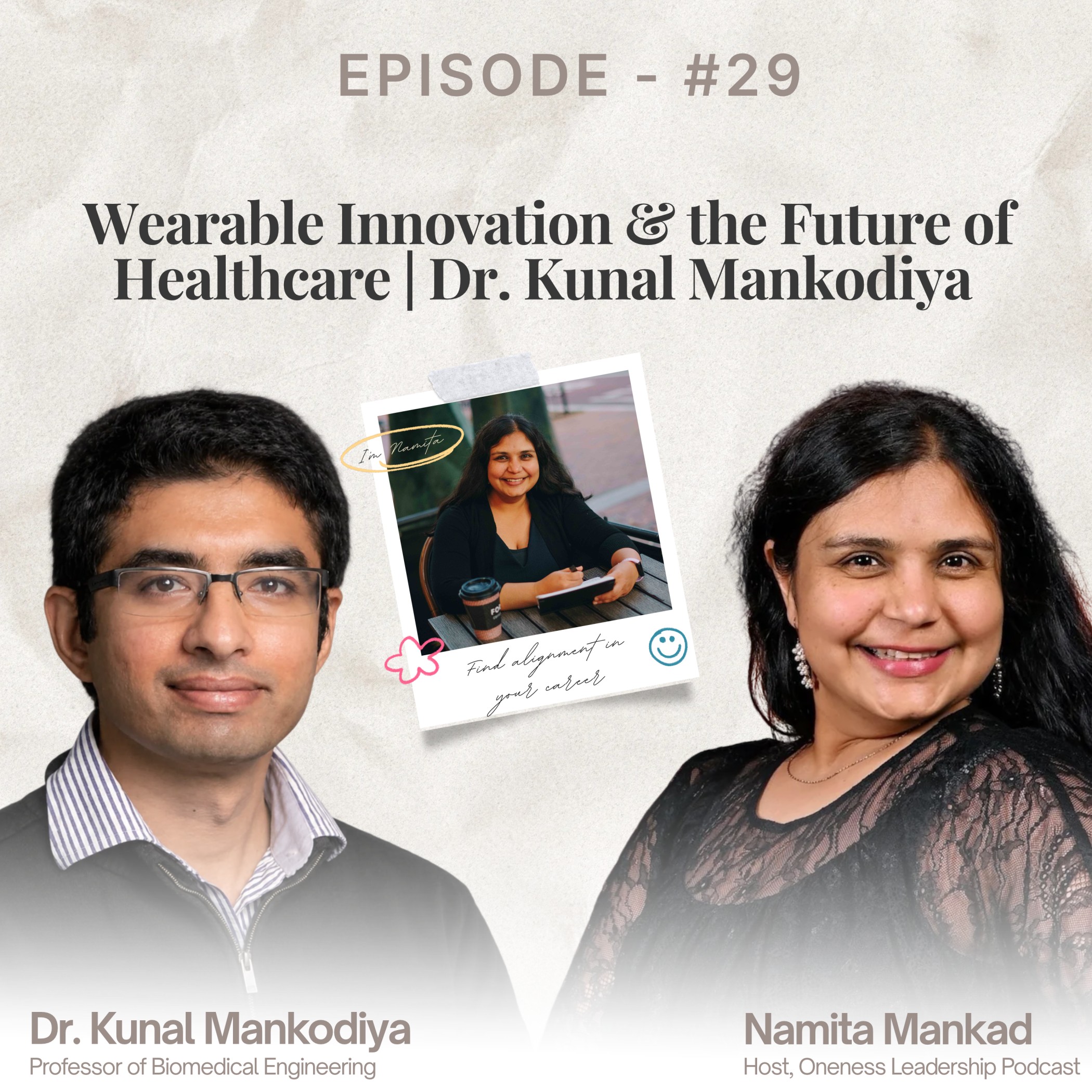
Additionally, Namita Mankad hosts The Oneness Leadership Podcast, released on 15 November 2026, and features wearable technology for women’s health.
It runs 56 minutes and features a playlist on wearable technology for women’s health.
Also on Amazon Music: https://music.amazon.com/podcasts/73f2c729-2ec6-4a40-a930-cfd498437c88
Moreover, this conversation concerns wearable technology for women’s health. It explains what it can measure, what it cannot yet claim, and what it asks of us.
The work the lab is known for began with a question from the clinic. Working with neurologists during his postdoc, he realized Parkinson’s symptoms needed objective, repeated measurement because meds are adjusted accordingly. “Why don’t we create a smart glove that would monitor fine motor movements?” The glove built by his lab carries sensors in the fingers, capturing fine and gross motor movement. It builds on existing clinical screening tests.
The research broadened to stroke, to virtual-reality applications, and to smart textiles such as T-shirts, belts, and armbands. The same sensing approach now underpins the lab’s work in wearable technology for women’s health.
Wearable technology for women’s health matters most, he says, and the science is still catching up. Moreover, designers did not build wearables around women’s bodies as the template. Researchers must study them across a woman’s life, allowing both generalizable findings and personal ones. His route to that data is the gentler one. It uses surrogate, non-invasive monitoring of signals the body already gives off — temperature, heart rate, pulse oximetry, electrodermal activity. With more research and personalised models, it could give a far better picture of stress and hormonal patterns. Additionally, his caution underscores the point: we should not claim any of this as measurement before it is proven.
Stress runs through the second half of the conversation. In the lab, his students are exploring whether electrodermal activity — the skin-conductance response studied for three to four decades — can track cortisol and heart rate closely enough to read stress without drawing blood. But a single reading, he argues, is close to meaningless: “Individualising stress and baselining it would be greatly helpful.” A baseline takes repeated measurements, at different hours and on different days, until “out of baseline” actually means something for that one person.
Then the argument turns around. However, are the wearables themselves adding to stress? Subconsciously, technology is adding a lot of stress. His generation watched the arc arrive. From no phone at home to wearables joining daily life around 2015–16. Nobody taught that generation how to handle it. Every notification stayed on, and the day became a long act of reacting. The answer he describes is not abandoning the phone, but governing it. Choose which notifications exist, and when Do Not Disturb applies. This insight also informs wearable technology for women’s health.
The conversation closes by leaving devices behind. Drawn by self-care and self-development, he followed his wife’s friends’ recommendation into a ten-day Vipassana course — a silent residential retreat where “mobile phones are given in, and you are by yourself for ten days” — and recommends it unqualifiedly: if life gives you the chance, try it at least once. Slowing down, reflection, community chosen for positivity, sleep judged by quality rather than a headline score: for the man who builds devices to listen to the body, the point of the technology is people learning to listen to themselves. “Technology is maybe a part of life, but it is not the life.”
Kunal Mankodiya, PhD, is a Professor of Biomedical Engineering.
He works in the Department of Electrical, Computer, and Biomedical Engineering at the University of Rhode Island.
He is the Director of the Wearable Biosensing Lab (WBL).
He holds a BE from Saurashtra University, India.
He earned an MS and PhD from the University of Lübeck, Germany.
He did postdoctoral research at Carnegie Mellon University.
He is co-founder of EchoWear, a spin-off from his lab.
EchoWear offers digital health technologies for neurodegenerative diseases.
These include Parkinson’s disease, dementia, and mild cognitive impairment.
He has mentored 18 graduate students and 3 postdoctoral researchers.
He has published more than 115 research papers.
Follow his research updates on LinkedIn—the social platform he is active on—through the University of Rhode Island: https://web.uri.edu/bme/meet/kunal-mankodiya/.
He also discusses wearable technology for women’s health in his TEDx talk on smart textiles for telemedicine.
Episode Transcript – Kunal Mankodiya with Namita Mankad (expand to read more)
Lightly edited for readability.
Episode Transcript
1. Welcome: classmates, years later
Namita Mankad: Hi everyone. I am excited to have a very curious discussion with Kunal Mankodiya today. Kunal is a professor of biomedical engineering at the University of Rhode Island, where he directs the Wearable Biosensing Lab — and, as we discovered, we share an alma mater and a graduation year, something neither of us had registered until we sat down to record.
Kunal Mankodiya: Thank you, Namita. It is a pleasure to be here. That connection makes this feel less like an interview and more like two classmates catching up, years later — on different journeys that somehow meet in the same place: health, technology, and how we actually live with both.
2. From a family clothing store to smart textiles
Namita Mankad: Let’s start at the beginning. Where does a professor of wearable technology actually begin?
Kunal Mankodiya: In my family’s clothing store in Dhrangadhra, a small town in Gujarat, around 120 kilometres from Ahmedabad — helping my father and uncle sell clothes as a boy. Textiles were simply the family trade. I never knew that I was going to be connected with the textiles again in the future — it was just helping out in the family store at that time.
Kunal Mankodiya: Biomedical engineering came next, almost by chance: I was lucky to take a seat someone else gave up, in the first biomedical engineering batch in Gujarat — a class of thirty. A master’s and PhD in Germany followed, and it was during the PhD that the two halves of my life first met: sensors embedded in clothing. My advisor backed the idea, and the Wearable Biosensing Lab I later founded at the University of Rhode Island grew from it.
3. A smart glove for Parkinson’s
Namita Mankad: Your lab is known for a glove. How did the smart glove for Parkinson’s begin?
Kunal Mankodiya: Parkinson’s disease is a movement disorder: tremor, slowness of movement and walking difficulties are its visible signs. During my postdoctoral research I worked alongside neurologists working on Parkinson’s, and they showed me where engineering could help — the symptoms themselves needed measuring, objectively and repeatedly, because medication is adjusted in response to them. Why don’t we create a smart glove that would be able to monitor your fine motor movements?
Kunal Mankodiya: The lab’s answer was a glove with sensors embedded in the fingers, able to capture fine motor movements and combine them with grosser movements, building on existing clinical screening tests. That research has since widened — to stroke, to virtual-reality applications, and across our wider smart-textile work: smart T-shirts, belts and armbands for physiological monitoring.
4. Wearables and women’s health
Namita Mankad: Popular wearables help, up to a point. But where is the gap for women’s biomarkers — and where is the opportunity?
Kunal Mankodiya: That is, cheerfully, the multi-million-dollar question — and the science is catching up. Bodies and internal processes differ, and research now has to be staged across a woman’s life — childhood and adolescence, young adulthood, midlife and older age — with room for both what generalises and what is personal. Women’s bodies were not the template wearables were designed around.
Kunal Mankodiya: My own interest is the gentler route to that data: surrogate, non-invasive monitoring. Rather than blood draws or samples, signals the body already gives off — electrocardiogram, pulse oximetry, temperature, and electrodermal activity, the skin-conductance response researchers have studied for three to four decades and that is now reaching mainstream wearables. With more research and truly personalised models, that could give a far better picture of stress and hormonal patterns across a woman’s life stages. The caution is part of the point: the models are not yet fully personalised, and more scientific research is required before any of this is claimed as measurement rather than promise.
5. Ayurveda, pulse and validation
Namita Mankad: There are older ways of reading the body. In Ayurveda, the nadi — the pulse read at the wrist — is said to carry far more than heart rate, and there are similar approaches in Chinese traditions. How do you, as an engineer, look at that?
Kunal Mankodiya: With respect — and with a question I leave open rather than taking a side on. Electrodermal activity can reflect internal stress, and research has explored its correlation with cortisol and heart rate, which is where a possible connection to hormonal patterns begins. The question is whether observations like nadi reading can be brought into research studies and validated, so that what experienced practitioners report can be tested properly — neither dismissed nor simply believed.
6. In the lab: stress, cortisol and reading the body
Namita Mankad: In the lab, you are researching whether electrodermal activity can track stress. What does that look like?
Kunal Mankodiya: The skin-conductance response is one of the best-studied signals in the body: it has been researched for three to four decades, and it is now reaching mainstream wearables. In the lab, my students are exploring its correlation with cortisol and heart rate — a question that is very close to the core of stress. We are also exploring whether electrodermal activity can be correlated with hormonal patterns. The next step is bringing the right people into the study — researchers and doctors who specialise in hormones and in cortisol — so that surrogate, non-invasive signals can be tested rigorously.
Namita Mankad: So the lab work is a bridge — from a signal we can measure to a state we actually care about.
Kunal Mankodiya: Exactly. And the bridge has to be built with the right partners, or it stays a promise.
7. Stress needs a personal baseline
Namita Mankad: Even if the signal works, what does a single reading tell us?
Kunal Mankodiya: On its own, very little. Individualising stress and baselining it would be greatly helpful — a baseline built from repeated measurements, at different hours and on different days. Without it, you cannot tell whether a high reading is stress or simply that person on that day. What you need to know is whether they are out of their baseline, because only then does a number become a judgement about that one person.
Namita Mankad: So personalisation is not a luxury here — it is what makes the measurement honest.
Kunal Mankodiya: Yes. A stress number without a baseline is a guess with a decimal point.
8. Is technology adding to your stress?
Namita Mankad: Here is the uncomfortable question. We are building all these devices to measure stress — and, at the same time, are they adding to it?
Kunal Mankodiya: Subconsciously, technology is adding a lot of stress. My generation saw the whole arc: no phone at home, and then suddenly wearables, joining daily life around 2015–16. We never really learnt how to handle it — every notification stayed on, and our days became long acts of reacting. I learnt to govern the phone instead of letting it govern me: choosing which notifications exist, and when Do Not Disturb applies. My view is not to abandon the phone — it is to decide what it is for.
Namita Mankad: That lands, because it is not a lecture from someone who has never felt the pull — it is a system that was learned the hard way.
9. Meditation, Vipassana and community
Namita Mankad: Where does meditation fit in all of this — the person as well as the professor?
Kunal Mankodiya: Meditation, prayer and community are the daily practice. I was drawn to self-care and self-development, and my wife’s friends’ recommendation brought me to a ten-day Vipassana course: a silent residential retreat where mobile phones are given in, and you are by yourself for ten days. I recommend it unqualifiedly — if life gives you the chance, try it at least once. Then there is the daily practice: meditation, prayer, and being in a community of friends who share that outlook.
Namita Mankad: And community is a choice — the people you surround yourself with set the conditions for the inner life.
Kunal Mankodiya: Yes — choose the friends whose positivity supports you, and the rest of the practice has somewhere to land.
10. AI, burnout — and how to follow Kunal
Namita Mankad: Before we finish — what about AI in this space, and the burnout question it raises for researchers and doctors alike?
Kunal Mankodiya: AI is the amplifier: it will make personalised models possible, if the data is honest. But the burnout question is the human one, and the answer is the same discipline — slowing down, reflection, and choosing community — applied to a working life that never switches itself off.
Namita Mankad: Kunal, thank you — for the research, and for the honesty about where the science is and where it is not yet.
Kunal Mankodiya: Thank you, Namita. I would love for listeners to follow the lab’s work: the Wearable Biosensing Lab at the University of Rhode Island, and my talks, including the TEDx talk on smart textiles for wearable telemedicine — https://web.uri.edu/bme/meet/kunal-mankodiya/
More from The Oneness Leadership Podcast: wearable technology for women’s health
Browse all episodes of The Oneness Leadership Podcast
Related episodes
- How Tom Dusenberry Conquered Change With a Fearless Heart
- How to Listen to Your Body: Neelam Kharod Sell
- How Matthew Harris Leads Security With a Watchful Heart
Join the Oneness Leadership circle
Join the Oneness Leadership circle.
Get the monthly newsletter
MORE EPISODES

Get the monthly newsletter designed by Namita for tech leaders and ambitious founders who are ready to lead with clarity, trust their intuition, and turn challenges into growth. Elevate your leadership, career, and impact.
Get the Monthly Newsletter
