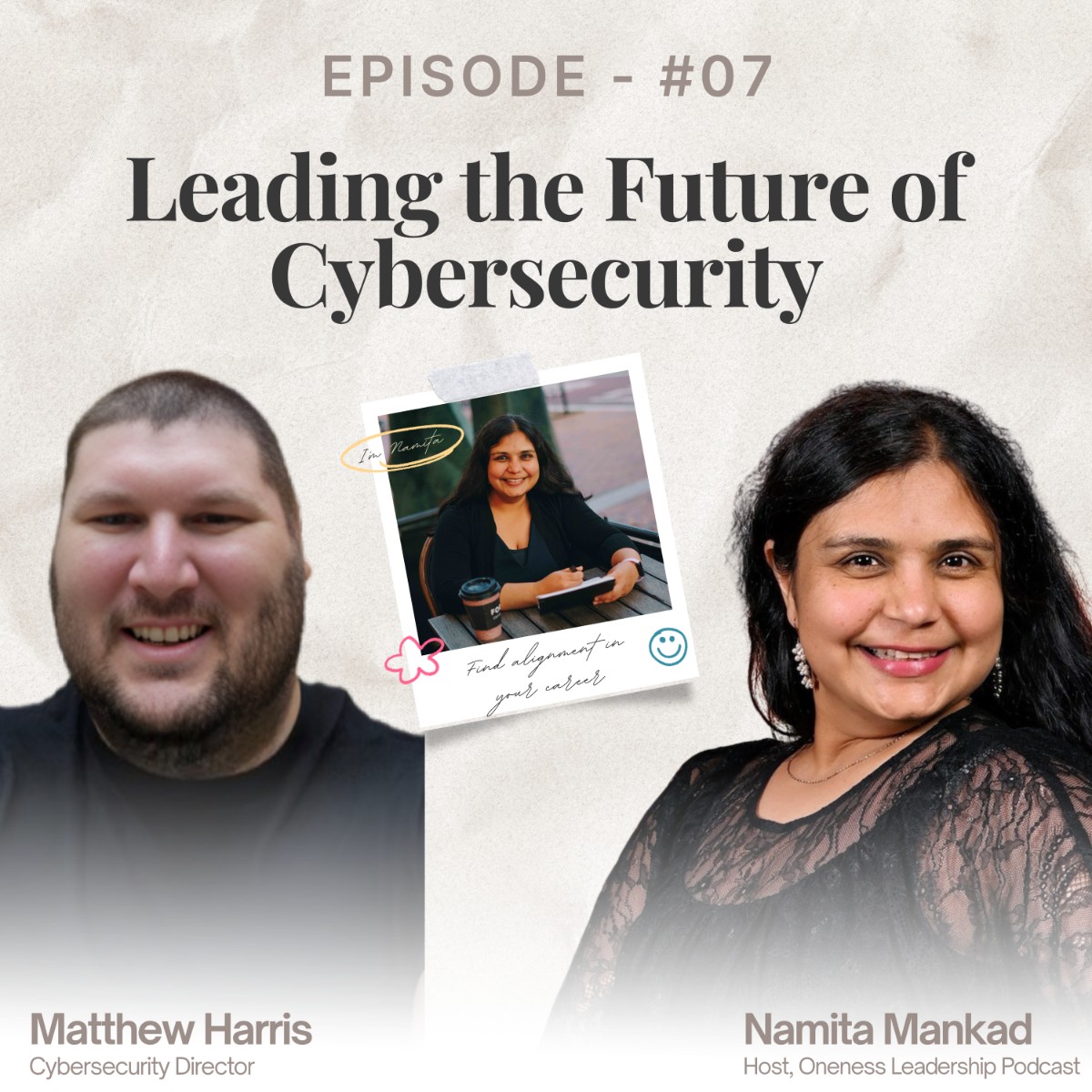
How Matthew Harris Leads Security With a Watchful Heart
March 17, 2026
Episode Overview
On this episode of the Oneness Leadership Podcast, Namita Mankad talks with Matthew Harris, a director of security in healthcare who came up from web development through security engineering. His work sits where compliance, patient trust, and digital defence meet, in one of the most regulated environments there is.
Matthew makes the case for patient-first security, for doing the basics before chasing fancy tools, and for integrity in work most people never see. It is a grounded conversation about protecting people who cannot protect themselves — on a show also known as the Wellness Leadership Podcast.
About the Guest
Matthew Harris is a cybersecurity professional and engineer specialising in information security, digital forensics, penetration testing, and security operations. He currently works in healthcare security as a director of security, where compliance, privacy, and patient trust are closely connected.
His path ran from web development into security engineering and then into leadership. His leadership perspective combines technical excellence with a strong ethical foundation, especially around protecting vulnerable populations and building systems that remain secure without losing sight of operational realities.
Connect with Matthew
LinkedIn: Matthew Harris
Key Takeaways
- Patient first. Matthew’s approach starts with the patient, not the doctor or the numbers: “security speaks for those that cannot speak for themselves,” and protected patients come back and refer others.
- Attackers only need to be right once. Defenders have to be right all the time — which is why the basics matter: no password reuse, a password manager, and keeping systems and security tools up to date.
- AI cuts both ways. Attackers use AI to spin up campaigns without deep technical skill; defenders use it to analyse logs and respond faster. And putting patient data into a public AI tool can itself leak that data.
- Compliance is never finished. Laws and regulations change constantly, regulations lag behind AI, and policies and best practice have to be kept ahead of both.
- Security is not just a cost centre. Framed through business continuity, visibility, compliance, and ease of use, security protects revenue, reputation, and trust.
- Integrity when no one is watching. Security work is unseen by the people it protects, so honesty carries weight: own mistakes, do the right thing, and be someone whose word can be trusted.
In Matthew’s Words
“Security speaks for those that cannot speak for themselves.” — on patient-first security
“Bad guys only have to be right once. Good guys have to be right all the time.” — on why defence is hard
“If you focus on the patient, then you’re gonna win most of the time.” — on where to start
“Just start off with the basics. If you do that, then you’ve got a good foundation to go through and build.” — on what organisations skip
“Whether somebody’s watching or not, do the right thing.” — on integrity
“We are security students. And we constantly learn, constantly adapt, and constantly evolve with that change.” — on never calling yourself finished
Conversation Highlights… (Expand to read more)
Episode Chapters
- Patient-first security in a world of changing laws
- AI and security: hackers, defenders, and data leakage
- The basics: passwords, updates, and being right all the time
- Losing sleep: priorities, vulnerabilities, and business impact
- From cost centre to business enabler
- Secure coding and the risks of rushing a product out
- Batman, childhood, and integrity when no one is watching
- Leading in security: selling what must be done, and legacy systems
Questions Namita Asked
How are your weeks overall, when it comes to dealing with security?
“It definitely, I love the challenge itself, and that’s what keeps me going.” Lately it has been difficult, with new laws coming: “pushing compliance, pushing how can we best protect our patients?”
It’s not easy to be 100% compliant at any point of time, because rules are continuously changing — GDPR, HIPAA, lots of state rules. How do you deal with all of this?
“My approach itself has always been patient first.” Boards look at numbers and productivity, so the work is to “balance out patient security” with staying afloat — and “if you focus on the patient, then you’re gonna win most of the time.”
What is your view on AI and security, especially when it comes to winning the trust of patients?
AI is “a tool” for streamlining operations, not an employee. On the security side, hackers use it to spin up campaigns and “you don’t have to be highly technical” anymore, while defenders use it to analyse logs and check “what’s real, what’s not.”
How do good guys keep up with bad guys?
“Bad guys only have to be right once. Good guys have to be right all the time.” The way to keep up is “by doing the basics” — no password reuse, a password manager, updates — “and using some of the AI tools to better enhance our security.” And be careful what you put into AI: a patient image pasted into a chatbot “can lead to data leakage.”
Is it policies that are keeping up with AI, or does there need to be more attention?
“There needs to be a lot more attention.” Regulations “are behind,” HIPAA is broad, so organisations need policies kept up to date and best practice and frameworks — and still, people “wanna do the fancy stuff” and forget to “start off with the basics.”
Do you lose sleep nowadays, because of what’s happening?
“Yes, I do.” Security “changes every day, sometimes multiple times a day” — “like going through, you’ve got a sinking ship and you plug one hole and another one pops up.” Prioritise by business impact: fix the server running everything before the laptop running the sound system.
Product development gets more budget and higher priority. How do you balance that as an executive in security?
“Security is viewed as a cost center” — in the transcript he calls that view a gut punch (see transcript). The shift is to show business continuity: “if we have protected them and they’re able to still continue to operate… you’re still making money.” He fits projects under “visibility, compliance, and ease of use.”
Tell us a little about your childhood and your hobbies
He is “a big fan of Batman” — the Adam West series especially — the oldest of his brothers, and “as stubborn as it gets,” which helps in a job where things change every day. Batman fed his drive “to help protect those people that cannot protect themselves.” His hobbies are movies, TV, his dogs Harley and Leo, travel, the beach, and cruises.
You relate integrity to your leadership style — patients are not watching, and you still want to care for them
“That’s what security should be.” Security people are “security students” who “constantly learn, constantly adapt.” On integrity: “You have to be honest, trustworthy, and what you say matters.” And: “If you make a mistake, own it.”
What are some of the challenges you are facing as a leader in security?
Selling projects that “need to be done from a compliance standpoint, but they’re not going to touch the revenue side,” and a constantly changing environment — including dental practice systems “written back in the nineties” that were “not written for a fully secured environment,” where admin rights can turn one exploited computer into access across the network.
How can listeners and viewers be in touch with you?
“Going through my LinkedIn is probably the best way” — he checks profiles first (“security first”), then is happy to set up a call to answer questions. His closing advice: “Don’t reuse your passwords and just be careful.”
Episode Transcript – Matthew Harris with Namita Mankad (expand to read more)
1. Patient-first security in a world of changing laws
Namita Mankad: Hi everyone. Welcome to another episode of the Oneness Leadership Podcast. I’m excited to welcome Matthew Harris, who is working as a director of security in healthcare.
That is a pretty challenging role. If you are not in the healthcare domain, or if you are, you would understand very well about all the regulations. He has been stubborn as a child, introverted, and he found his way through some challenges, from web developer to security engineering, and then now he grew as a director.
So welcome, and thanks for joining us, Matt.
Matthew Harris: Of course. How’s it going?
Namita: It’s great. I’m going to have lots of questions for you. I can’t resist but to know how your weeks are overall when it comes to dealing with security — not a popular role, but very vital.
Matthew: Yeah, you are so right. It’s not everybody’s cup of tea. I think that’s not for everyone, but I definitely love the challenge itself, and that’s what keeps me going.
Lately it has been very difficult. We’ve had quite a few changes, not just with us, but there are new laws and things that we’re looking for that possibly will come out. We’ll just have to see how all of that stuff goes.
But from my side of things: pushing compliance, pushing how can we best protect our patients? That’s where things are at right now. Getting a game plan, and yeah, it should be fun.
Namita: What I understood is that it’s not easy to be 100% compliant at any point of time. You have to be on top of that, because rules are continuously changing. For example, GDPR, HIPAA being very complex, lots of state rules.
So how do you deal with all of this, while working with doctors and patients and making sure they’re happy, they’re getting services on time, and taking care of the security from the back end?
Matthew: For sure. My approach itself has always been patient first. I know that’s not the most popular, because doctor first has been some of the biggest selling points. But patient first: how can we best push protection, security, things for those patients themselves, because security speaks for those that cannot speak for themselves.
And that’s the biggest challenge, because a lot of times your board, whoever you’ve got at the top, looks at the numbers, looks at your productivity, and looks at how much income they can bring in, because it’s a business. So you’ve got to balance out patient security: how can we best serve them, how can we still make money, still stay afloat.
And right now, with those constantly changing laws — that’s just what they are right now, they’re constantly changing laws, and it constantly evolves every day. And that’s something that security itself, you just have to stay on top of it. Doctor happiness, doctor-first mentality, sometimes good, sometimes bad. But if you focus on the patient, then you’re gonna win most of the time.
Namita: Oh, that’s amazing. So what you are trying to say is that when you are thinking patient first, if you take care of patients, then doctors will automatically get business.
Matthew: Exactly. If you focus on your patient experience, patient security, then patients will want to come back. If you can focus on what’s better for your brand, better for you, better for them, and they can refer you out to their friends and family — “Hey, come and check this guy out, come and check this girl out, they’re really good, really on point” — and we still protected them.
Namita: That’s a great point. I think the trust of patients is very important.
2. AI and security: hackers, defenders, and data leakage
Namita: Let me bring AI in here. We live in the era of AI, and sometimes questions come around ethical standards. How do you see that happening in the industry you are in? What’s your view on AI and security, especially when it comes to winning the trust of patients?
Matthew Harris: That’s a big question. There’s a lot with AI itself. Let’s start with the base. We need to view that as a tool.
How can we best use that to streamline operations, streamline whatever productivity you can? In a sense, that’s how we can use it now. Unfortunately, some people are viewing it more as an employee, where we’ve all heard things about laying people off to replace them with AI.
Some jobs, some different roles might be through replacement, but things need to transition, and I think in the end that’s gonna be the way things are. But as far as how it touches on security, there’s a lot more to it.
You’ve got everything from hackers that are using AI and good guys that are using AI. I would say good guys, bad guys, but that all falls into perspective, so we’re just gonna call it hackers and good guys. Hackers themselves can use AI to spin up what we’re gonna call a campaign.
Basically that’s an event: multiple attacks going toward one group. They’ll spin up different campaigns to attack different groups with AI. And you don’t have to be like you used to be.
Back in the past, you had to be highly technical, really know your stuff, know a lot about it. Now you don’t really have to have that, because AI does a lot of that for you. And good guys are using that too: how can we defend against those attacks?
Having AI analyse different things, like your logs that are coming in from your antivirus and stuff along those lines, to check to see what’s real, what’s not.
Namita: No, it does answer my question. But my next question is: how do good guys keep up with bad guys? Because I’m pretty sure bad guys have a lot more to gain.
Matthew: So bad guys only have to be right once. Good guys have to be right all the time.
3. The basics: passwords, updates, and being right all the time
Matthew Harris: Adding on to the complexity, you’ve got to continue to be better. Just basic things can be done. Follow the basics. Password reuse is a big one.
Don’t reuse your password across everything. Use something like a password manager, so you have to know one passphrase and it has a bunch of complex passwords. Just makes it easier on you.
Make sure your computer, phone — whether you’ve got a Mac or a PC or Android or whatever you have — makes sure it stays up to date. Make sure your security tools stay up to date, whatever you have, Windows Defender or Bitdefender, whatever.
These are not promotional, I’m not getting paid for any of this, but just make sure stuff stays up to date, and that’s critical. Be careful who you talk to online.
It used to be, if you don’t know somebody, stranger danger type of deal — that’s all transitioned over. You don’t know who you’re talking to online. Be careful what emails you open up.
You just have to be careful, because stranger danger, to a certain extent, can come back and bite you, because the bad guys only have to be right once. We gotta be right all the time. And the way we are staying with them is by doing the basics, and using some of the AI tools to better enhance our security.
Namita: That’s great. So what you’re saying is, it is still everyone’s responsibility. Even though we know there are tools like AI which can parse a lot faster, if you are careful, then you can protect yourself, your company, your patients, your doctors, everyone.
Matthew: And be careful what you put into it. This is something we have seen within the industry itself: AI is adaptive and can learn very quickly. However, putting something like a patient image into ChatGPT and saying, “What’s wrong with this?” can lead to data leakage.
So you’ve got to make sure, whatever platform you’re using, be careful what you put into it, because you can lead to patient data records actually getting out. You can lead to images of all sorts getting out. You just have to be careful. Be smart about that.
Namita: That makes sense. The tools are coming every day. They’re claiming they could be better than doctors, but then the issue is: how do you preserve privacy? How do you preserve security? Is it policies that are keeping up with that, or regulations? Does there have to be more attention to that?
Matthew: Let’s just say there needs to be a lot more attention. Within the organisation, you need to have your policies and procedures kept up to date. That needs to be key, because try to stay ahead of where the regulations are, because the regulations are behind.
They truly are. And HIPAA, because we’re talking about healthcare, is very broad, so you’ve got to look at best practices. There’s all sorts of frameworks you can follow to make sure you don’t miss anything or forget anything.
But AI itself has changed so much of the way we used to do things. It’s really made an impact. Just keep up with those policies and procedures, that way you’ve got something to fall back on.
Make sure you also follow the current laws and regulations that are there, and just be smart, practice best practice. And do the basics. That’s what a lot of people miss out on: they wanna do the fancy stuff, jump to the fanciest tools, but we forget that. Just start off with the basics. If you do that, then you’ve got a good foundation to go through and build.
Losing sleep, budgets and secure code… (expand to read more)
4. Losing sleep: priorities, vulnerabilities, and business impact
Namita: Do you lose sleep nowadays, because of what’s happening?
Matthew Harris: Yes, I do. It’s gotten bad enough where I did have to upgrade my bed finally, and yes, I know, but it’s gotten a little better. But still, there’s a lot, because it’s an ever-changing world.
It doesn’t stop, security. It changes so often. Security changes every day, sometimes multiple times a day.
Namita: Wow.
Matthew: It’s like going through, you’ve got a sinking ship and you plug one hole, and another one pops up. What do we do first with that? Speaking to some of your business leaders: make sure you’ve got a business impact analysis, to know where your critical systems are, what to target first, then work your way down.
So for your security leaders that are out there: just because it’s a high vulnerability score, doesn’t mean that’s what you need to target first. If you’ve got a server that’s running everything, it’s got one vulnerability, then you’ve got a higher level of vulnerability on this laptop that just runs the sound system — let’s go touch the server first, then we can talk about the laptop.
So it’s all about where your priorities are, where that lies, and just making sure that you have — that’s part of the basics, that’s part of governance, things along those lines — to identify where you’re at, what’s going on. Because if you don’t know, that’s a whole blind spot in your environment.
5. From cost centre to business enabler
Namita: When you talk about priority, I have seen in the industry that product development gets more budget and higher priority, and sometimes security would have to say, no, we need a budget. And generally, this always is: we need more budget.
Because, as you said, it is sometimes changing multiple times a day. How do you see that someone like you, who is in an executive position in security, balances this?
Matthew Harris: This is an interesting question. Unfortunately, security is viewed as a cost center. And that is unfortunately a big gut punch to many of us that are in the industry, going: look, we saved you from getting this, it would’ve cost — but which one takeaway was some leadership, and things along those lines, is actually this exact discussion: how can we turn security from a cost center to being viewed as a revenue maker?
That’s why you’ve got your development team that’s been pushing out features, because they’re making money, they’re bringing that in. That’s why these customers go with this vendor, because they’ve got the features that they want. Security itself is: you’ve protected us, we didn’t get hacked, that’s great. And then when something goes wrong: why didn’t you protect us?
If we had this tool, or if we would’ve done this, then it would’ve done so. It’s looking at your business continuity, things along those lines. That’s going to be where you can start to actually drive change, drive basically that image that security is just a cost center. Because if we get breached, first, security has to clean it up.
But if we have protected them, and they’re able to still continue to operate — yes, we might have a problem, but you’re still making money. And that’s been one part that’s very difficult to sell to any business. It doesn’t matter who you’re talking to.
But things like that really make an impact on how we can push the business forward, still align with their goals, but push things like compliance, which I’ve actually got written on my board behind me: visibility, compliance, and I call it ease of use. How can we fit all of our projects within those categories, to first make it easier to sell, because we’re not trying to sell a fancy framework, but how can we streamline that?
How can we impact revenue positively? And if we can streamline operations, optimize workflow, then security can be a great benefit to every organisation.
Namita: Yeah, I’m with you. Even the reputation of the company, that’s huge.
Matthew: Exactly.
6. Secure coding and the risks of rushing a product out
Namita: I did a little bit of web coding myself, so I could clearly see the difference between creating the right infrastructure and how much it takes, versus web coding nowadays. People just put up their startup product.
I came to the point, after I did my web coding, my product was live, and I’m like, oh my God, the security, the compliance. I immediately said, okay, I need the expert. And I took the right steps for my startup, but not many people understand this.
Matthew Harris: People see — you mentioned vibe coding. You’ve gotta be careful with a whole lot of that, because a lot of that does not have secure coding in mind. Just for many of your listeners, when we talk about secure coding, we’re looking at things like input validation, to make sure they can’t perform things like SQL injections, things like that, that are really bad, can expose whatever database you have on the back end that it’s pulling all that information from, or actually poisoning that database.
Because you’re talking about a reputational impact: if your site is not providing accurate data, you’ve got a problem. And if somebody has modified that on the back end, you’ve got a bigger problem.
So sadly that’s being overlooked. That’s not being viewed as a priority, because it’s all about how can we push this out quickly. I understand making it easy on yourself and streamlining it, but there are steps you don’t want to skip.
Namita: And of course, I am with you. People think AI is going to replace developers, but I honestly feel developers can smartly use AI. But the biggest risk I’m seeing is this security, compliance, privacy.
Matthew: Totally. That’s so true.
Batman, integrity and leading in security… (expand to read more)
7. Batman, childhood, and integrity when no one is watching
Namita: That’s a lot about what you are doing, but we would like to also learn a little bit about your childhood and what your hobbies are.
Matthew Harris: Sure. I was a big fan of Batman. Still am. I love it.
This is my childhood right here. The one that I’m showing is the one with Adam West, the complete TV series, compared to some of the others — just like having a nice hand-painted picture of some of that as well.
My childhood itself: I grew up with mom, dad, and I’ve got some little brothers as well. I’m the oldest, so you’ve gotta love together and push that path sometimes. But I’m as stubborn as it gets, which definitely helps me in my job, in not giving up, because things change every day.
Batman was, and still is, a good figurehead, a good model to push, especially the Adam West Batman. He did a fantastic job. As things progressed throughout some of those movies and the series, it got a lot darker — not just how Adam West was, where you’re looking at the citizens and let’s protect them, to just a darker, more — like The Dark Knight is a great example of that, how it’s just gotten so much darker.
I like the lighter version. Great comedian, he does a good job along those lines. But I think that’s actually fed into a little bit of where I am today. I look to see how I can speak, and help protect those people that cannot protect themselves.
That’s been a fantastic part of my childhood and my adulthood. Still going. It’s not over yet. So this is one of those that’s been a good part of that.
That’s the motivation that keeps me going. That’s what keeps driving me. Because unfortunately, our patients can’t speak for themselves. They don’t know what we’re doing.
That’s on me to go: okay, think about this. What is your dentist doing with your data? You hope they’re doing what they’re supposed to, but how do you know? I can tell you that if I’m the person that’s over security for the org, then I’m doing everything I can to push and fight for you, and that’s where I belong with that.
You mentioned hobbies. I work a lot, but I love movies. I love watching TV shows, and hanging out with my dogs, Harley and Leo. I don’t get a whole lot of extra free time, because within the org we’ve got a lot going on, but I take every bit of free time I can to hang out with the pups, if I can grab some dinner with a friend, things along those lines, to help my sanity, but also to step away from the job a little bit.
But I like to travel. I just got back from Hilton Head, South Carolina. It was beautiful, just gorgeous, and I loved it.
I like the beach, and I love cruises, so it’s the best of both worlds, and cruises have lots of food. I’m pretty sure you love food.
Namita: Oh, way too much. I really hope my doctor’s not watching this. He’ll kill me, but I ate way too much, and had way too much fun. I had one cruise to Alaska. It was awesome.
Matthew: Yeah, that’s my favorite spot. I did Princess Cruise, the inside track. It was gorgeous, with the Glacier Park.
Oh, it was amazing. It was so cool to get to see some break off. I will do another one. I will go back.
Namita: Totally. You mentioned something that I would relate with your leadership style: integrity. Because even though patients are not watching, you want to care for them.
So you’re not only acting as a superhero for them, to protect them, protect the weak, or protect those who don’t know what’s going on, but you are showing integrity even when no one is watching. You want to make sure things are right.
Matthew: Yeah. That’s what security should be. That’s not just me, that should be security itself. It falls to not just making sure you’re ethical, and not doing something you’re not supposed to, but making sure you’re fighting for what needs to actually happen to protect those that can’t.
Not everybody’s a security expert. In fact, those that are experts should not call themselves experts. We are security students. And we constantly learn, constantly adapt, and constantly evolve with that change.
We may know more than others, but it all falls back to integrity. If you say that this is wrong — I know this is morbid, but say your grandmother passes away, and you tell me your grandmother passed, I better not see granny walking down the street, where there’s gonna be an issue. I’m gonna believe what you’re telling me, a hundred percent.
Security itself, you have to be honest, trustworthy, and what you say matters. What you say carries weight. If I tell you this is what’s wrong, you can bank money on it saying that’s what’s wrong.
And so, for your listeners: be open and honest. If you make a mistake, own it. That’s the biggest thing I tell people: don’t try to hide it, own it.
Just be open, be honest, and whether somebody’s watching or not, do the right thing, because it’s gonna come to light no matter what it is. Your name will carry weight as someone who is trustworthy, someone who is honest.
That’s one thing that I’m going through, trying to hire somebody or whatever: you’ve gotta look at the integrity side of it, because I can’t have somebody who’s not trustworthy working security. We’ve got a big problem.
Namita: No, that makes sense.
8. Leading in security: selling what must be done, and legacy systems
Namita: That brings to the next question. What are some of the challenges you are facing as a leader in security?
Matthew Harris: Different challenges, different projects along those lines that might not fully impact revenue, but need to be done. Those are difficult to sell, because I’m taking something — let’s take, without going into specifics for my org, because I don’t want to get — looking at something along the lines of: if money isn’t being spent on just security, where it does not help the office, then it’s not being spent on the office, or marketing, or a data warehouse, or anything along those lines to drive revenue. So right now, one of the challenging parts for me is selling some of those projects that we actually need to get done from a compliance standpoint, but they’re not going to touch the revenue side.
Another one is the constantly changing environment, and I know I touched a little bit on that in the beginning, with some of the vulnerabilities and things. But the environment changes, and dental — you’ve got healthcare, and then you’ve got, inside that, which is 10 years behind, you’ve got dental. And so trying to lock down insecure dental, I would say, is a very large challenge, given many of the practice management systems.
You’ve got things like EMR, EHR — that’s your electronic health record, electronic medical records. In dental, we call them practice management systems, all saying the same thing. And many of those were written back in the nineties, when this was not — we might as well be playing Pong half the time — but it’s not written for a fully secured environment.
And different practices — this may be a little deeper than you want — but admin rights being on the computer for the practice management system to run, something along those lines, that’s a very simple example, but that’s a huge hole, because if that computer is exploited, now you’ve got somebody with admin rights, able to run across the network. So things like that, you’ve gotta find ways to mitigate that, while still keeping things operational.
Namita: No, that’s great. That’s a very good point. I think someone who is listening now has a startup — I would love to go something that covers all specialties, that you can have a base model, sell different features to specialise in each specialty, fully integrated.
Possibly cloud would be fantastic. So whoever’s listening, it’s free, it’s yours. Do with it what you will.
And I guess if you would like to have Matt on board as an advisor — eventually retirement is in my future. Let’s be less gray here. It would be fantastic.
Matthew: That’d be good.
Namita: Oh God, that was fun. How can our listeners and viewers be in touch with you, Matt?
Matthew: Going through my LinkedIn is probably the best way to keep in touch. If you go through and reach out, there’s a good chance I’ll probably check your profile, make sure you’re real, then go through — hey, security first. You gotta love it. You did pass, and thank you.
Go through, reach out over LinkedIn. We can have a conversation. If you’ve got questions, reach out. There’s a good chance what I’ll do is I’ll probably set up just a Google Meet or Teams meeting or something with you, to address those questions.
Because security changes on a daily basis. We didn’t even touch on things such as spammers and scammers. Try not to talk to them. Just report and block.
That’s normally one of the best ways to handle it. Do not respond to that email saying, “No, please take me off your list,” because that will add you to more lists. So please don’t do that. That’s a horrible idea.
Unless you want to train your spam filter, please don’t do that. But there’s so much, as far as security, that we could touch on, because it’s such a vast field, and it’s an ever-changing field.
So just be careful what you click on. Stranger danger. If you did not request it, go to that actual site. Don’t interact with that email, go to the site, and just be smart. Don’t reuse your passwords, and just be careful.
Namita: No, thanks a lot. This was a wonderful conversation. We covered a lot, and we have a lot more to cover, maybe sometime again.
Thank you for your time, and I am looking forward to getting feedback and replies from the listeners and viewers.
Matthew: Of course, and thank you so much for your time. This was fun. This was a very different type of podcast. Looking forward to continuing.
Namita: That sounds perfect. Thank you so much for your time.
MORE EPISODES



Get the monthly newsletter designed by Namita for tech leaders and ambitious founders who are ready to lead with clarity, trust their intuition, and turn challenges into growth. Elevate your leadership, career, and impact.
Get the Monthly Newsletter
