From Technology to Meaning: Christoph Dressel on Karma, Conscious Leadership & Designing a Life That Matters
March 25, 2026
Episode Overview
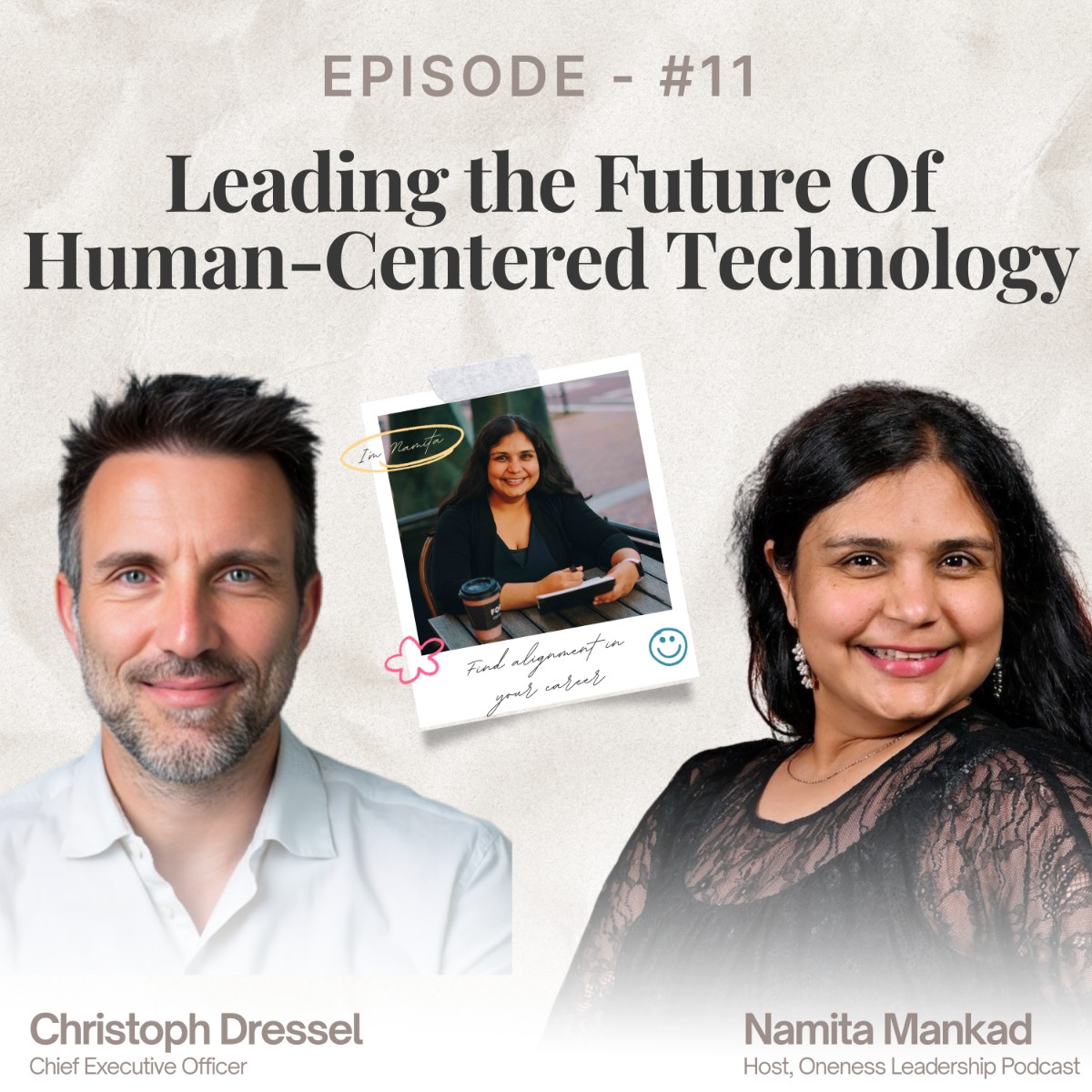
On this episode of the Oneness Leadership Podcast, Namita Mankad talks with Christoph Dressel, a technology entrepreneur who has spent more than 20 years building products that bring people closer together. He created Bond Touch, the bracelet that sends a touch to a partner far away. He now works on movement-based care for Parkinson’s and longevity.
Christoph shares the low point that sent him deep into yoga and the philosophy of karma. He talks about what he got wrong when he gave employees ownership, and why fatherhood at 46 rewired his priorities. It is a heart-led leadership conversation about building with meaning, not just for markets.
Key Takeaways
- Karma as a leadership practice. Put good energy in and good energy comes back. Give your best effort, then let go of the result.
- Build for meaning, then measure it. Bond Touch reached about $30 million in revenue, but weak retention made Christoph question whether it truly helped relationships.
- Ownership isn’t for everyone. He gave five key employees 8% each. It worked for three, and two would have been happier with a salary and no partner pressure.
- Designing for happiness. Bring users into the design process early. Testing with 8 to 12 people catches most problems and ends ego battles on the team.
- Rest makes you better at the job. No one does more than six to eight hours of truly focused work a day, and good decisions need downtime.
- What matters at the end. People at the end of life name their family and their relationships, not money or houses.
Conversation Highlights… (Expand to read more)
Episode Chapters
- The turning point: yoga, karma and letting go
- The story behind Bond Touch
- Why he left, and the move to Parkinson’s and movement
- Giving employees equity: what worked and what didn’t
- Designing for happiness
- The Bay Area vs. Europe
- Becoming a father at 46
- Burnout, focus and what really matters
In Christoph’s Words
“If you put good energy in, you will get good energy out. If you put bad stuff in, bad stuff will come back to you. It might not be very fast, but the logic is very sound.” — Christoph Dressel, on karma
“You give your best, you make your best effort. Then there’s a moment you have to just let go.” — on non-attachment
“What the heck is more precious on this planet than quality of lifetime?” — on why he moved into Parkinson’s care
“That freaking prestige sometimes can lead you to wrong decisions, which are not good for your personality and the way you wanna approach life.” — on giving employees ownership
“Just assume nobody knows nothing, but we go out, we ask the users and we have some hard data.” — on designing for happiness
“There’s no superhumans out there. There are people who are more focused and less focused.” — on burnout
About the Guest
Christoph Dressel is a technology entrepreneur and innovation strategist with more than two decades of startup experience, including several company builds and exits. He came up with the idea for Bond Touch, the connected bracelets for long-distance couples, which grew to about $30 million in revenue. He founded a software development company in Portugal and has advised Fortune 500 organizations. Today he is building a movement-based approach to Parkinson’s and neurodegenerative conditions, focused on adding years of high-quality life. He is a trained yoga instructor and lives in the Bay Area.
Connect with Christoph
- LinkedIn: linkedin.com/in/chrisdressel
- Websites: kwamecorp.com, eae.pt
Questions Namita Asked
Looking back, what inner shift most shaped the leader you are today?
A hard stretch: he was separating from his partner and was “really tired of the company.” He had been drinking too much, then “running to the yoga studio, sweating all that out again.” He went deep into yoga, became an instructor, and found that karma gave him “a really good structure.”
What inspired Bond Touch?
On a Valentine’s Day away from his wife, the texts felt redundant. He wanted “something more visceral, something on your skin”: one device where a touch becomes a vibration on your partner’s wrist. “That was a pretty stupid idea at the time… and then that turned out to be actually very viral.”
And how about now? MimoFit is a different thing.
Bond Touch made about $30 million, but retention was weak and some couples became controlling. He moved into Parkinson’s care, where exercise “three, four times a week, half an hour” showed big gains with no side effects. “We can add five to 15 years of high quality of life.”
How do you balance giving employees equity and sharing information?
At his Portuguese software company, “any value in the company is in the people’s heads.” He gave five key people 8% each. It worked for three, and two would have preferred a steady salary: the “prestige sometimes can lead you to wrong decisions.”
Tell us about your publication “Designing for Happiness.”
It is human-centered design: bring users in early, because “assumptions are usually wrong.” It is cheaper, less risky, and the team is happier too, with no “weird ego battles.” He says testing with 8 to 12 people sorts out the vast majority of problems.
What are the pros and cons of Europe versus the Bay Area?
“Business wise, I don’t know any better place than the Bay Area.” But business there is often transactional and the community moves around a lot. For living, he would choose Spain or Portugal for the warmth and deeper connection.
What has parenting taught you?
He never planned to have children and became a father at about 46. “My son was born and I realized how stupid I was.” The egocentric lifestyle fell away: “it really changed me to a much, much better person.”
What’s your message for leaders who are burning out?
Long hours lowered his productivity. Nobody gets more than six to eight hours of focused time a day, and good decisions need downtime. He protects two hours with his son each evening, because at the end of life people name “my kids, my wife, my family.”
Episode Transcript – Christoph Dressel with Namita Mankad (expand to read more)
Full Transcript — Christoph Dressel with Namita Mankad
1. The turning point: yoga, karma and letting go
Namita Mankad: Hi everyone. Welcome to another episode of the Oneness Leadership Podcast. There are builders who chase markets, and then there are builders who chase meaning. My guest today has spent over 20 years building technology that does one thing at its core: bring humans closer to each other and to what matters most.
From connected bracelets to longevity science, he has always asked the same question: how do we use what we build to make life more meaningful? Welcome, Christoph Dressel, to the podcast.
Christoph Dressel: Thank you. Thank you for having me.
Namita: Thanks a lot. Looking back, what inner shift or moment of awakening most shaped the leader you are today?
Christoph: I think there was one significant moment where I went through a really hard time. I was separating from my partner at that time. I think the company was actually doing okay, but I was really tired of the company. I couldn’t see it anymore. Each new client, however big the contract was, it was like, oh, okay.
That was a moment when I took a really deep dive into yoga. I was always practicing yoga, but not in a very disciplined way. There was a time when I was drinking too much alcohol. Not to the level of an alcoholic, but definitely too much. And then the next day, running to the yoga studio, sweating all that out again.
I was thinking, why do you put all that poison in you and then just go out and try to clean yourself? So I took a really deep dive. I actually became a yoga instructor and went deep into the philosophy. That was a significant change in my life.
The guidance of the yamas and the niyamas, these rules and prescriptions, helped me a lot. And the whole concept of karma. It’s super important. I’m not saying I wasn’t a very ethical person before, but it gave me a really good structure. A much better structure than Christianity maybe is able to provide. Suddenly everything made much more sense for me, even though I was raised in a very Christian environment.
Namita: So what you’re saying is that the shift was about being spiritual and understanding who you are from within, rather than seeking validation, even religiously, from outside.
Christoph: Yeah, because it makes so much sense, right? If you think about karma: if you put good energy in, you will get good energy out. If you put bad stuff in, bad stuff will come back to you. It might not be very fast, but the logic is very sound. It makes a lot of sense, even on a scientific level.
And then simple things, like when you go through something hard. There’s this concept of Ishvara Pranidhana, self-surrender. You give your best, you make your best effort. Then there’s a moment you have to just let go.
You did everything you could, and then you have to receive it. It’s okay, stop stressing, because it’s done. You did everything to your best, now you live with the results, and whatever comes will be okay somehow.
Namita: Yeah, definitely. I think what you’re saying, in a modern way, is performance with non-attachment. Give it a hundred percent, and let it unfold for you. Whatever is in alignment, you’re going to attract.
In yoga and some of those spiritual philosophies, it’s also Nishkama Karma: do your best, but don’t expect the fruit. Don’t aim for “I should get this because I’m doing this.” And things definitely come back to you in good ways.
Christoph: Yeah, there’s a lot of this. Just letting it go. Sometimes we get super tight: now I need to do this, I need to get this contract. But maybe not, because life is bigger, right? You don’t know everything.
So many things are based on our assumptions, and we get trapped. Sometimes it’s just: let it go, and see what happens.
Namita: You’re right. That is very liberating. Two things you mentioned here. The principle of karma is very important, because many people believe, and I always correct them, that something bad happened to them because they did something bad to that person. That’s not true.
The energy you put out is a vibration that comes back to you. Karma is not tit for tat. It’s deeper than that, and that’s what you bring here, so thank you.
Letting go is super important too. Sometimes we think, if I do this work, I will earn this much money, and then I’ll have this kind of life. But why set these means goals? There’s a teaching that says you should have end goals: I want my life to be happy and peaceful, and let it unfold.
There’s a really good one from Mike Tyson. Do you know him, the boxer?
Christoph: I know him, yeah.
Namita: There’s one thing he said that I love: everybody has a plan until they get punched in the face.
Christoph: I love it. I have been punched, I think, a hundred times.
2. The story behind Bond Touch
Namita: This is amazing. So after being punched in the face, I see that the companies you are building are super meaningful. Before we get to that, I’d like to know the backstory. What inspired the bracelets, Bond Touch?
Christoph: I lived in Portugal for a long time, and my wife was with me there. Then a lot of my projects and my clients moved to the US, and I started spending long stretches in the US. It happened to be Valentine’s Day, and I was sitting in the Bay Area.
And I thought, now I have to send all these text messages to my wife: I miss you. Everything feels so redundant. I’m not a very romantic guy, unfortunately. Sorry to my wife, she’s suffering from that. But I like hugs, and I thought, can’t we do something like this remotely? Even if it’s not a proper hug, maybe something more visceral, something on your skin.
Wouldn’t it be nice to have one device where, when I touch it, it creates a vibration on my partner’s wrist? Nothing else happens on this device, just me touching her by sending this vibration. When it arrives, she knows exactly that it was Chris, thinking about her at that moment and wanting to send her some good vibrations.
That was a pretty stupid idea at the time, and nobody took it very seriously. Then it turned out to be actually very viral, and people really loved it. There’s a segment of long-distance relationships where people really connected to it. So the company turned out to be very successful.
Namita: Amazing. That’s very out of the box. And it’s true, because love languages are different. Not everyone is good with words. Especially today, when everyone is so busy, you don’t have to communicate or show love only one way. So that’s very smart.
3. Why he left, and the move to Parkinson’s and movement
Namita: And how about now? MimoFit is a different thing.
Christoph: There was one thing about Bond Touch that kind of bothered me, and eventually I left the company, because there was a great opportunity to leave. Bond Touch had a problem. The sales were great. We made $30 million in revenue. Profit margins were really high. It was a well-oiled machine.
But the retention rate wasn’t great. People used it intensively for some months. The target group was also very young, so lots of times we had product returns because, “Oh, I broke up, but I didn’t even receive the product yet.”
Namita: Oh my God. That’s funny.
Christoph: In the end I asked myself, is it actually helping people to be more romantic, to be better and to stay in touch? From customer support we also heard that maybe it’s not the wedding band 2.0, maybe it’s handcuffs 2.0.
Some people, not everybody, became quite possessive and controlling: “Oh, you touched me, you didn’t touch back.” Guidance was missing. I really wanted to take the company more into relationship guidance and relationship counseling, and create positive things.
But when I left, the company was producing quite a bit of electronic trash, if after some months it just goes in the gadget bin. So I wasn’t sure it was a really good company if it didn’t move more toward relationship building, or something that teaches emotions.
Then I found MimoFit. Actually, it kind of came to me. It wasn’t really me picking it. A very good old friend came to me with the idea, and they already had the clinical trials done. I really dove into the space of Parkinson’s and neurodegenerative diseases, and I saw that the current healthcare system is very dominated by the pharmaceutical industry.
Sorry, a little sidetracked. We know that exercise is very effective for dealing with neurological conditions. There are hundreds of papers and publications out there. But our current healthcare system in the US is not providing that. There’s no systematic provision of good exercise.
For you and me it’s obvious, because nature says there’s atrophy. If we don’t use certain parts of our body, nature will get rid of them. If you don’t use a muscle, the muscle becomes very thin. Add a sedentary lifestyle, bad eating habits and a lot of information coming in without really processing it, and that leads to an increase in neurological conditions.
But there’s a very simple thing: just a little bit of movement, three or four times a week, half an hour. Our clinical trials have shown massive improvements. Very natural, zero side effects. Nothing compared to what standard drugs currently do in terms of side effects.
When I understood that we have a very simple way to make a huge dent in people’s quality of life, that we can add five to 15 years of high quality of life, I thought: what the heck is more precious on this planet than quality of lifetime?
Namita: Yeah. What is better than that?
Christoph: And there was a way to provide this to people, and business-wise it’s also a really good company. I said, heck yeah. This is exactly what I want to do. Let’s jump on that.
Namita: Amazing. I watched the video, by the way. I know you’re focusing on Parkinson’s disease right now, and that seems like lots of fun. If I gave one of those to my niece or nephew, I’m pretty sure they’d enjoy it. They’re very active. It feels so natural, so much fun to move with it.
Christoph: We frequently take it to our backyard parties and birthday parties, and the kids love to play it. It’s like a game where you can play one versus one or two versus two, and that’s a lot of fun. They really get some energy out, which is really good for the kids. I’ll hook you up with a set. I’ll send you some.
Namita: Thank you. Yes, it’s like having fun. You’re not thinking, oh, I need to work on myself. It’s more like I’m having fun, almost like dancing. I do dancing. A few years back I wanted to lose some weight, and I didn’t even realize it: I was dancing every day and I lost so much weight. It just happened.
Christoph: Yeah, exactly. Because you’re enjoying the moment.
Giving employees equity, designing for happiness, and the Bay Area vs. Europe… (expand to read more)
4. Giving employees equity: what worked and what didn’t
Namita: Cool. I know we talked about equity with your employees. The balance when someone is part of your company: whether to give them stock as equity, and what level of transparency to give them with information. So there are two questions. One is about money and stock, and the other is about sharing information. Both are super important for any business that is listening. I’d like to know your thoughts and experience.
Christoph: I had some experiences with that. This was my second company, a software development company I created in Portugal. At that time the company was doing okay-ish. It wasn’t great, but it was okay. But we always had a lot of trouble keeping employees on board, and I hated it.
In a software development agency, all you have is your people. There’s no machine, nothing like that. Any value in the company is in the people’s heads, and maybe the book of clients you have. It’s not the boss. It’s really the people. And whenever somebody left because he got a better job or whatnot, I thought, this is so bad.
Europe was quite a bit behind the Bay Area. Here it’s very common to give shares. In Portugal at that time, there wasn’t even a legal framework for vesting shares and all that. It didn’t exist.
And I was sitting there saying, I love these people. I really want to be with them. Why don’t I just give them a good chunk of ownership? I don’t care if I own all of the company. It’s not only about the money. If we all share, we all make decisions.
I’m a big fan of making decisions together as a team, because usually they’re better. My decisions are pretty awesome, but definitely inferior to a group decision in many cases. So I gave five of the most important employees, who had proven themselves, 8% of the company each.
Namita: Oh, wow.
Christoph: At the time I thought, this is the best thing I ever did. This is fair, everybody gets profit share and whatnot. Then after many years, some of these people left the company. I haven’t been operational there for many years, but only now has it crystallized.
People said, actually, I don’t want to be a partner. I don’t want to stress about new projects coming in and what we do with the profits. I feel much more comfortable working in a big company, getting my salary every month. At six o’clock I go home and I don’t think about anything else.
So it worked very well for three of these people. But for two of them, I just gave them the shares. They didn’t have to pay, or paid just a minimal fee. And for them, I’m not sure I did a good thing.
There’s always this societal pressure, because it’s prestigious: now you’re a business owner, you’re a partner in the company. And that freaking prestige sometimes can lead you to wrong decisions, which are not good for your personality and the way you wanna approach life.
Namita: That’s very deep. You’re right, we have lots of expectations from society when it comes to money and building your life. Sometimes it keeps people trapped. Everything looks perfect from the outside, and it is not.
Christoph: Makes sense.
5. Designing for happiness
Namita: I also read some of your publications, and one title that caught me is “Designing for Happiness.” I’d really like to know a little more about that.
Christoph: Designing for happiness is one of my favorite things. It’s centered on human-centered design, or user-centered design, as we called it before. It came around 2010, when user experience designers and user experience actually became a thing.
Before that, software and product development was done on a waterfall principle. People sat in their offices and said, oh, this would be awesome, with lots of assumption on top of assumption. Then they built for half a year, the product shipped, and everybody went, oh shoot, it didn’t work at all. People actually don’t like it.
So the idea was, if we design something for people, we need to get the people in much, much earlier in the design process. Assumptions are really bad, because assumptions are usually wrong. If you get users in and start testing really early, checking or realigning your assumptions, the end user becomes part of the design process.
It makes it cheaper, because you’re not building a huge application and then seeing that 60% of it is absolutely not working. Then you have to refactor the code and refactor your hardware, which is super expensive. If you do little incremental releases and keep testing early, it’s much better for product development. It’s much less risky. It might take you longer to get out, because you have all these iterations of testing.
But the happiness part is not only the happy customer in the end. The team who’s creating it is much happier too. What happens, especially with executives, is that somebody comes in and says, I like blue, everything has to be blue, and my assumption is better because I worked at Apple. Still, nobody knows anything.
If we find common ground and say, hey, just assume nobody knows nothing, but we go out, we ask the users and we have some hard data, that’s much stronger than what’s coming out of your brain based on assumptions. It makes it much easier for the team to align and say, okay, this is what we have, I can be behind this. We don’t get into these weird ego battles of “I know better than you.”
Namita: I think that’s very important. I am designing too, and yes, I’m going slow, which is against the startup way. It’s not natural. Mostly every day I have to tell myself: patience. My business partner also believes in that, so it makes it easier.
Sometimes pausing is better than to keep building because you think you know something. From customer discovery, what I’ve heard is that unless you hear the same thing from 75 to 100 people, make sure it’s worth building. I’ve heard many stories where you build all the features and then it fails. People say, okay, I’m in a two-week sprint, I’m building this output, but you’d rather not. That is hard, but it’s actually worth it.
Christoph: It’s totally worth it. And the miraculous thing is that 8 to 12 people is actually enough.
Namita: Oh, okay.
Christoph: You don’t need 75 or 100. If you talk to 8 to 12 people and you do it in a proper way. Sometimes you still have executives who are super headstrong and married to their ideas and beliefs.
So do the user testing in a completely unbiased way, and ask the user: here it is, what do you think? Ideally it’s even a person who is not involved in the product development, so it’s not biased. With 8 to 12 people, you get the vast majority of things sorted out very early. So it’s actually not that hard.
Namita: That’s good to know. I’ll try 10 people, and I’ll have more confidence in that. Thank you.
6. The Bay Area vs. Europe
Namita: You mentioned the culture in Europe versus the Bay Area. What are some of the pros and cons? In Europe you gave partnership, and it worked for about 60%, maybe a little more. Since your company is in the Bay Area right now, I’d assume you like the Bay Area more.
Christoph: It’s funny, I’m totally bipolar in this way. I love the Bay Area. I love the US for doing business. But it’s often very transactional. It’s cold. It’s also a very transient community, so people come and go. It’s really hard to have long-term relationships here, because people move around a lot.
I love life in Europe. I call myself a European Latino. I love Iberia, Spain, Portugal. That’s where I really feel at home. My wife is from Argentina, so that also says something, right? I really like the warmth and the deeper connection between people. It’s much easier to connect and be with each other. So business-wise, I don’t know any better place than the Bay Area to work, to get stuff done and to do things. For living, I would always go to Spain or Portugal.
Namita: I totally understand and relate. I’m based in the DC area. If my nephew had not been born, I would have been somewhere on the West Coast. But he keeps me here.
Becoming a father at 46, and burnout, focus and what really matters… (expand to read more)
7. Becoming a father at 46
Namita: Since I brought up my nephew: I know you have kids. I’d like to know a little about your parenting. What advice do you have for future parents?
Christoph: Parenting was a huge surprise for me. I never really wanted to have a kid. I was always open to the idea. It sounded great, but if it had not happened, I would have been happy as a pig, doing my thing.
But then my wife came to a point and said, we have a kid now, or it’s over. I said, whoa. I was already pretty old. When I had my kid I was 46 or something like that.
Namita: Oh, wow.
Christoph: And I said, okay, I think you made the decision for us. Then my son was born, and I realized how stupid I was. There’s something universal happening to us when we have this baby in our arms.
There are several aspects to it. There’s this unconditional love coming to you without really chasing it. Nature, or the universe, just comes and slaps it in your face.
Namita: I am with you.
Christoph: For me it was like, holy moly, you knew nothing before. How could you not want to have that? The meaning of life is suddenly completely turned around. I stopped driving. I was a crazy motorcycle driver, doing all this weird stuff. A very egocentric lifestyle, traveling, very indulgent. Suddenly all of this fell away, and I thought, this is absolutely not that important anymore. There’s this little dude who is eclipsing almost everything.
I almost felt like those parasites in nature. I think it’s a sort of wasp. They lay eggs in snails, and the larvae take over the brain of the snail. It happens with ants and with snails. They take over the brain and make the host do things to help them procreate.
It sounds really bad, but it’s not in a bad way. The hormones, the feelings, everything gets rewired. I thought, whoa, my whole brain is not the same person anymore, just in a good way. Having that kid really changed me into a much, much better person.
Namita: I’m with you. I didn’t have my own kid, and I would have loved to have one, but I have my nephew and niece, and I can totally relate. When my nephew was born, luckily I was there with my family during COVID, almost two years. That’s the reason I did not move to the West Coast. Why would I want to work for a tech company or anything? I want to be with him.
Christoph: It’s fantastic. Totally.
8. Burnout, focus and what really matters
Namita: We are almost coming to a close, and I have one last question, about longevity and staying healthy while building startups, especially since you’re working on a longevity startup. As you mentioned, you gave up a lot of that old lifestyle and took on a much healthier one. What message do you have for leaders who are burning themselves out, or founders who want to make things happen?
Christoph: I think I have one message, and it was a great learning for me. Before, I thought, I can do it. I can work seven days a week, 10 or 11 hours a day. But it took me a bunch of years to realize that my productivity and my efficiency actually went down, even though I had the feeling I was doing a lot. You’re just not thinking that well.
Everybody who believes they have more than six to eight hours of focused time per day is just fooling themselves. It’s just not happening. There are no superhumans out there. There are people who are more focused and less focused. It pretty much boils down to that.
If you have a job that demands thinking, you need downtime to process all the information that comes in. That’s how you make proper decisions that are good for the business and efficient in the end.
Right now I’m in a very critical phase of our startup, so I’m actually working too much. I’m really good at talking about it, but sometimes I’m not really good at doing it myself.
Namita: That happens to everyone.
Christoph: But I’m really trying not to work on weekends, at least not the full weekend. I really try to stop at six and then have two full hours just being with my kid. Because that is the other message: time is so precious. It just flies away. My kid is nine years old now, and I already missed so many years because of work.
There was big research where people were interviewed just before they died, in a hospice. Rich people, poor people, successful people, unsuccessful people. They were asked one question: what was really important in your life? And the answer was almost unanimous.
It was not, oh, I made so many millions, I bought all these houses, I took all these amazing vacations. No. It was my kids, my wife, my family, how I connected to people. It was always the social connections that really mattered.
Life will end for all of us. So what is really important? Stuff? Or having people around you who will actually love you for who you are, and not for what you have?
Namita: That’s an amazing message. Thanks a lot. You’re right: ultimately, what matters is love in your life, the true connections. Everything else is superficial. So how can people be in touch with you? Should they follow you on LinkedIn?
Christoph: Yes, of course. Find me on LinkedIn, under my name.
Namita: Thank you. I enjoyed this conversation so much, and thank you for sharing this deeper philosophy of life. I’m pretty sure listeners will enjoy it. Thank you for your time.
Christoph: Thank you. It was very nice.
MORE EPISODES
Get the monthly newsletter designed by Namita for tech leaders and ambitious founders who are ready to lead with clarity, trust their intuition, and turn challenges into growth. Elevate your leadership, career, and impact.
Get the Monthly Newsletter
