The Powerful Way Kwame Patterson Gives Voice to the Voiceless
April 15, 2026
How Kwame Patterson Uses Storytelling to Amplify Unheard Voices
Episode Overview
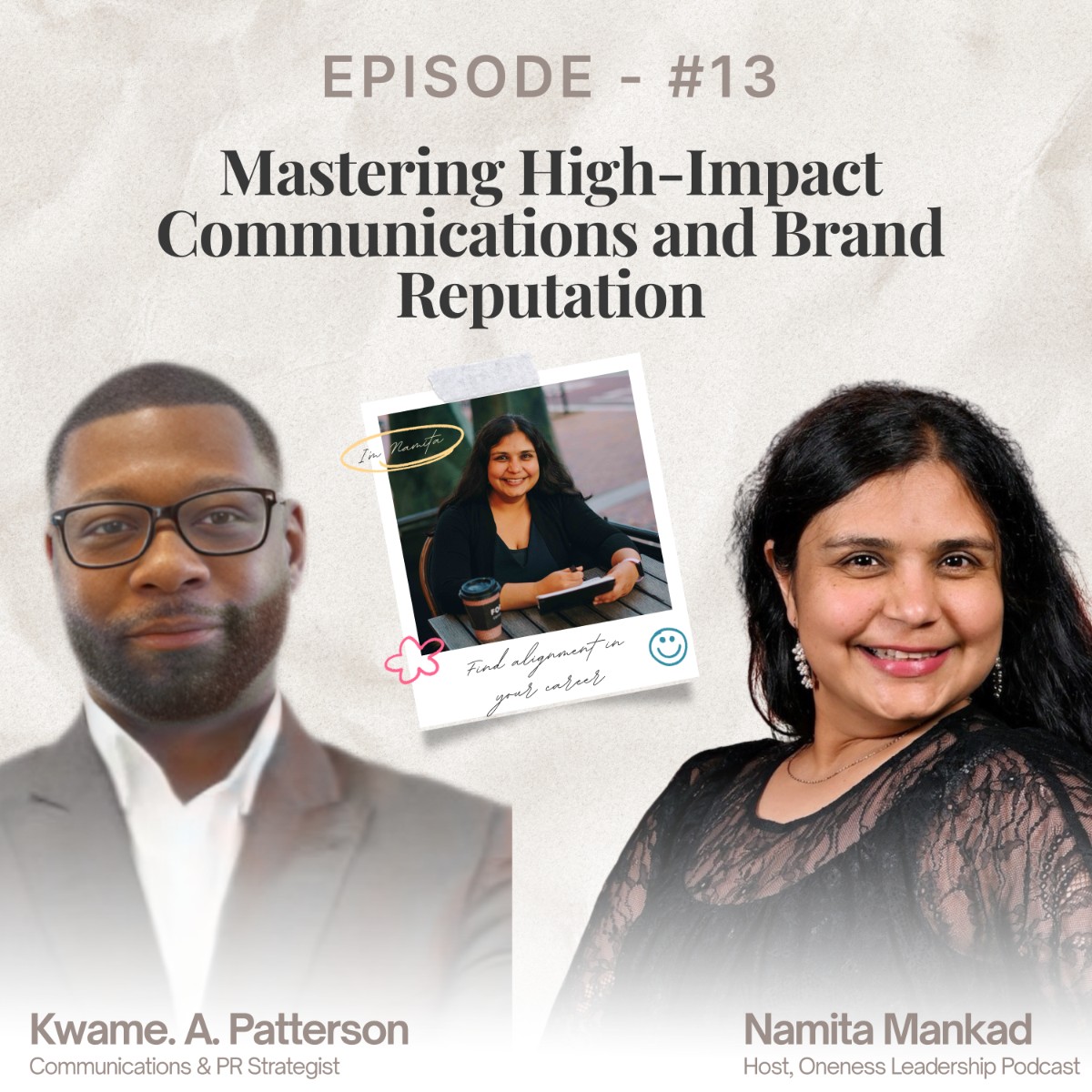
On this episode of the Oneness Leadership Podcast, Namita Mankad talks with Kwame Patterson, a leader in strategic communications, crisis management, and data-driven storytelling. He works at the intersection of narrative, policy, and public impact, helping organizations craft messages that not only resonate, but influence outcomes at scale.
Kwame shares why, in a world where information is constant and attention is limited, the real challenge is not just being heard — it is being understood, and being trusted. The show, also known as the Wellness Leadership Podcast, explores how leaders use storytelling not just to communicate, but to create meaningful impact.
About the Guest
Kwame Patterson is a strategic communications leader with expertise in crisis management, narrative building, and data-driven storytelling.
His work focuses on helping organizations communicate with clarity, purpose, and impact, especially in complex and high-stakes environments.
Kwame brings a unique perspective to leadership, blending storytelling with data to create narratives that resonate with diverse audiences while driving measurable outcomes.
He is deeply passionate about using communication as a force for equity, alignment, and societal impact.
His work spans high-impact PR campaigns and crisis communications, aligning messaging with organizational values, and integrating ESG insights, media relations, and AI-driven tools into communication strategy.
Connect with Kwame
- LinkedIn: Kwame Patterson
- Facebook: Kwame A Patterson
- Instagram: @left2write
Key Takeaways
- Communication is a core leadership capability. It is not just a skill — leaders must ensure their message is not only understood intellectually, but resonates emotionally.
- Storytelling turns data into action. Data provides credibility and the foundation; storytelling creates connection and brings data to life. Together they create meaning and drive action.
- Trust is built with intention. Clarity, consistency, and empathy build trust — and in crisis and uncertainty, communication becomes stabilizing, helping people navigate ambiguity.
- Narratives shape outcomes. Stories shape perception, and perception influences decisions — so leaders who understand narrative can shape outcomes, not just messages.
- Communication carries responsibility. It is not neutral: it shapes how people think, feel, and act, and it carries weight for equity, inclusion, and representation.
- Clarity creates alignment. Translating complexity into clarity aligns internal teams and stakeholders, and shapes organizational culture.
In Kwame’s Words
“I used to write my stories, my words, my feelings on the walls in my parents’ house.”
“Instead of reacting out of fear and out of pressure, we chose to slow things down.” — on the decision over his unborn son
“Leadership to me is service. It is not authority.”
“Listen more than talk.”
“AI is a great support, but again, the key word is support. It should not be the lead.”
“We cannot lead alone.” — his closing words
Conversation Highlights… (Expand to read more)
Episode Chapters
- Welcome: a communications leader shaped by faith and family
- The awakening: from newspaper reporter to advocate
- A family of orators: the quiet child who wrote on the walls
- The defining moment: advocating for his unborn son, Story
- Loss and new life: his parents’ deaths, his daughter Song’s birth
- Partnership: growing together through the thick and thin
- What leadership means beyond titles: service, not authority
- Servant leadership in practice: psychological safety and the “why”
- The challenge now: AI in communications — support, not the lead
- How to follow Kwame
Questions Namita Asked
Looking back, what inner shift or moment of awakening most shaped the leader you are today?
“A multitude of things.” He started as a reporter — a print journalist for newspapers in different cities — “and that was what grounded me. It’s what kind of gave me my bones, so to speak. But it also really brought out that storytelling element in me, but also getting the story right, and actually giving voice to community issues.” Twenty years of that led through government, organizations, and major corporations. “But as you said, what really shaped my ability within leadership, within communications, within my advocacy work is being a brother, being a son, being a husband, being a father.” Both his parents are pastors: “their value system for us, really for me and my siblings growing up, really is what shapes how I push advocacy and communications now. And I carry that with me into everything I do.”
You are the son of pastors — and everyone in your family chose some form of communication, and you chose storytelling. How was growing up in that family, and how did it make you who you are today?
“I come from a family of orators.” His two brothers and two sisters all went into ministry and are pastors and great public speakers. “Growing up, I was the quiet child. I didn’t say much. And always kind of felt outside of that speaker ability that they seemed to have so much talent in. I was always in my head. However, I used to write my stories, my words, my feelings on the walls in my parents’ house — much to the chagrin of my mother, writing on her walls in crayon. But that is where my stories — that is where I put my stories. And I discovered early on: I want to tell stories. But I just don’t have the verbiage or the ability to articulate them out vocally, because I felt so dominated within the household of these great speakers. And so I chose the written word, in the written form, to communicate.” It started around age four and “has led me to be a writer, first and foremost.” Growing up a preacher’s kid, he watched his parents’ community advocacy — soup kitchens, helping people facing homelessness — “that also drives that storytelling element… as a leader, I always kind of have that leadership microscope toward the people and the stories, advocating for them, giving them greater voice and support.”
The challenge you had when your son was about to be born, and doctors had certain opinions — would you share those challenges, and how you made the decision against all the practical advice, following your intuition and faith?
“I look at that as a defining moment in my leadership. And the most defining one did not happen at work.” Doctors told them, while his son was in outer, to consider terminating the pregnancy: the specialists “couldn’t detect or find his heartbeat” on any scan. “In the moment, stakes extremely high. First child between me and my wife. And the information was uncertain. And the pressure to decide was immediate.” Instead of reacting out of fear, “we chose to slow things down… we leaned into our faith. And then we came together to become advocates for an unborn son who had no voice in the decision of whether he would live or not. And that’s what meant the most. And that’s how I lead now.” Today he has “a healthy six-year-old son” — named Story, a name they had chosen while dating, before any of this. And why the monitors failed: “He was too animated and active in the womb, to where the monitors could not keep up with where his heart was pumping.”
Your struggle didn’t end there. You had your daughter three months after your parents passed away, back to back. How was that challenge, with a little son already?
His father died of gastrointestinal issues; a year later his mother died of pancreatic cancer. He had just started a new job as senior communications director for a national healthcare institution; his wife was pregnant through his mother’s sickness; three months after his mother passed, his daughter Song was born. “As leaders, not only do we have to compartmentalize, but we also have to ensure that our personal lives do not impact the work and impact the people. It’s a saying: bring your whole self to work. I believe in that. I understand that. It sounds good. As leaders, sometimes we have to bring our best self to work.” The loss was neither secret nor identity: “I didn’t make it me. And it didn’t let it determine how I lead. We push forward. We move forward.” And at home, his wife as partner carried the grief with him.
What message do you want to give to leaders, when it comes to understanding what a healthy relationship is?
“Whoever your partner is — my partner is my wife. Married almost a decade. And we’ve been through the thick, thin, and theater of it all. The challenges, the highs, the lows. And we’ve been kind of superheroes together through that.” A partner who shares your values — “equally yoked in spirituality and faith” — knows your strengths and weaknesses, and can take what you can’t take to colleagues: “I can take to my partner. I can take to my wife. And we can suss it out, settle it, flesh it out together.” He tends to be “very black and white, linear… problem, solution, A and B” — a trusted partner “can show you other pathways to success… partnerships and engagement and vulnerability, and having a village — the cliche ‘no man or woman is an island’ reigns very true in my family.”
With everything you have experienced — faith, family, advocacy, relationship — what does being a leader mean to you today, beyond titles or roles?
“First and foremost, leadership to me does not equal influence.” Parenting clarified it: with two young children, “if you’re not clear, if you’re not present, if you’re not consistent, they tune you out, or they push back. You can’t lead them all the same… as a leader, you’re always being looked at and examined.” Sometimes the best move is patience: “Not every situation needs retaliation or reaction. Sometimes, as a leader, you step back, and you have to just see things from 3,000 or 30,000 feet above, and see that a problem could possibly solve itself.” His short answer: “Leadership to me is service. It is not authority. That includes advocacy, support, clarity, and responsibility.” Pressed further, he adds: “In charge means you’re responsible. It does not mean you’re pointing and demanding action” — lead from the front, be a mentor and coach, practice psychological safety “where people feel safe to make mistakes, people feel safe to speak up,” listen more than talk, and give teams the full picture: “People need to feel part of something bigger, and know that their work actually matters.”
What are some of the challenges you are facing today, in your world, that you want to resolve next?
“I’m currently focused on strategic communications and reputation management, and helping organizations, companies really see themselves and tell their story, to connect to their audiences and build their brands through storytelling.” The live challenge is AI: “I’m really focusing, in training and consulting, on how to incorporate AI into communications systems, leadership visibility — and also ethical means and ways to use AI. Not just put it into the system and let it do the work. AI is a great support, but again, the key word is support. It should not be the lead.” He has “downloaded everything I know — and all the strategies and tactics that I use… that were effective — into my book, which is called Communicator’s Brew, on Amazon… goal-oriented strategic communications.” Through it all, he is “still carrying along the values and morals of what my parents have given to me, as well as keeping my partner, my immediate family, and my extended family close to the chest, and ensuring that it isn’t just work… A leader should be well-rounded.”
How can people be in touch with you, or follow you?
“You can email me directly at Patterson@gmail.com. You could also follow me on Instagram, at left2write… And you can also follow me on Facebook, at Kwame A Patterson. And they can buy my book on Amazon. You can find it on LinkedIn too, under the same name: Kwame Basis Patterson.” His most responsive channels, he says, are “Facebook, Instagram, and that email address.” He closes: “We cannot lead alone. And you have been willing to have that deeper discussion and open it up to others. So I hope it helps.”
Episode Transcript – Kwame Patterson with Namita Mankad (expand to read more)
Lightly edited for readability.
1. Welcome: a communications leader shaped by faith and family
Namita Mankad: Kwame, thank you for joining me. Hi, everyone. Welcome to another episode of the Oneness Leadership Podcast.
Today we are going to have a heart-led conversation with someone who has been doing communication as a profession for 20-plus years. Today I am joined by Kwame Patterson, a communication leader with over 20 years of experience. His journey began in journalism, and was deeply influenced by growing up as a son of pastors, where storytelling and voice were part of everyday life.
What makes his voice powerful is how he carries that into real life, as a husband, as a father, and someone who has had to advocate fiercely for his family in the moments that truly mattered. Welcome, and thank you for joining me.
Kwame Patterson: Thank you so much, Namita. Thanks for having me on your show. I appreciate your introduction, and the pleasure to speak with you and your audience today on a very important matter when it comes to leadership — and just the system skills, life experiences, and career experiences that have helped shape my leadership skills, brand, and abilities. So thank you again.
Namita Mankad: Yeah, absolutely.
2. The awakening: from newspaper reporter to advocate
Namita Mankad: OK, so looking back, what inner shift or moment of awakening most shaped the leader you are today?
Kwame Patterson: It’s a multitude of things. I look at myself as a communications leader focused on helping organizations kind of build a reputation, and navigate through tough spots, very complex issues, even crisis, in order to shape who they are, their brand, build their voice. I started — and you’ve already alluded to it in your introduction, you’re right on point — but I started as a reporter, a print journalist, working for a number of different newspapers in different cities throughout the country.
And that was what grounded me. It’s what kind of gave me my bones, so to speak. But it also really brought out that storytelling element in me, but also getting the story right, and actually giving voice to community issues — things, and personal stories that people were going through.
And kind of over the past 20 years, that’s led, and been kind of the ground and foundation work, for what I’ve done for government, for multiple organizations, as well as major corporations throughout my career. But as you said, what really shaped my ability within leadership, within communications, within my advocacy work, is being a brother, being a son, being a husband, being a father — and really grounding, and really understanding those complex, familiar issues, and having that support, and having that importance, and having that kind of working structure behind me and pushing me, and guiding me.
As I said, both my parents are actually pastors. And their value system for us — really, for me and my siblings growing up — really is what shapes how I push advocacy and communications now. And I carry that with me into everything I do, but that’s the standard I bring within my career as a leader.
Namita Mankad: Great. No, thank you for sharing that.
3. A family of orators: the quiet child who wrote on the walls
Namita Mankad: So, your son — I mean, you are the son of the pastors, not just pastor. OK, good to know. And I remember you mentioned having a loving family and siblings as well.
And everyone chose kind of like, you know, some form of communication, if I remember correctly. And you chose storytelling. So how was that environment? How was growing up in that family, and how, you know, that made you who you are today, especially when it comes to storytelling and delivering the correct message?
Kwame Patterson: Very good question. Very deep question. So if I can get philosophical here: I come from a family of orators. As I said, two parents who are pastors.
My additional siblings — I have two brothers and two sisters — they’ve all gone into ministry, and all are pastors in their own rights and fields, and are great speakers, public speakers. Growing up, I was the quiet child. I didn’t say much. And always kind of felt outside of that speaker ability that they seemed to have so much talent in.
I was always in my head. However, I used to write my stories, my words, my feelings, on the walls in my parents’ house — much to the chagrin of my mother, writing on her walls in crayon. But that is where my stories — that is where I put my stories. And I discovered early on: I want to tell stories.
But I just don’t have the verbiage, or the ability, to articulate them out vocally, because I felt so dominated within the household of these great speakers. And so I chose the written word, in the written form, to communicate. And that was for me — I mean, it started around four.
Not going to tell you my age now. But it’s traveled through decades. And that has led me to be a writer, first and foremost. In writing, I believe that is where I can really tell the stories in ways that can travel beyond just words, but be on paper.
And stories can last forever on paper. And I can express myself without having that fear of being overcrowded, overshadowed, over talked, within the written word. So that kind of set the whole tone — that type of family structure, and that type of writing ability that I did carry with me, and I did hone it. And so I went to newspapers.
I wanted to be a screenwriter — still working on that. Got a few screenplays out there. But being a newspaper reporter — and that’s why I say newspaper, specifically, because that was the writing portion of it — it has just come down to advocating for a voice that hasn’t been heard, or needs to be heard more, which goes all the way back to a childhood — I won’t say trauma, but a childhood mechanism or structure within a large family of orators.
Namita Mankad: Amazing. So there’s a story behind why you are advocating for others.
Kwame Patterson: Yes, definitely. And also growing up as a PK — they call it a preacher’s kid — really seeing my parents be community-minded, really having empathy and advocacy for their members and for the community, and really basing that help and support for the people in communities on their faith — that also drives that storytelling element. I’d see the soup kitchens.
I’d see when they helped those who needed to pay their phone bill, facing homelessness, those who may be struggling with a sick family member, family members sick themselves — just going through a multitude of issues, and depending on their faith and the leadership from their pastors, and how my parents helped advocate for and support those particular efforts, for decades, for years. That was my example.
And that is where those stories lie, even today. Even as a leader, I always kind of have that leadership microscope toward the people and the stories, advocating for them, giving them greater voice and support.
Namita Mankad: That’s amazing. So I think what you are saying here is: having faith in difficult situations. And I think your parents gave that to hundreds and thousands of people as pastors.
Faith, family and a defining moment… (expand to read more)
4. The defining moment: advocating for his unborn son, Story
Namita Mankad: And that leads to my next question. I am sure about the challenge you had when your son was about to be born, and doctors had certain opinions. You are strongly showing me that you would not have done that without faith, because that was a challenging situation.
I’m pretty sure that your wife has this strong faith too. Would you like to share some of those challenges, and how you made the decision against all the practical advice, following your intuition and faith?
Kwame Patterson: I look at that as a defining moment in my leadership. And the most defining one did not happen at work. But it definitely leads to how — or kind of gives the — is the north star in how I am a leader, and how I like to lead, and how I come to decision-making, and how I facilitate challenges.
So one of the most defining moments was with my son. It was when doctors told us, while he was in outer, that my wife and I should consider terminating the pregnancy, because they couldn’t detect or find his heartbeat. And all the scans, all of the best medical equipment, and all the best — I’d say heart doctors; I can’t think of what their specialty is called right now. I should.
Namita Mankad: Pediatric specialists?
Kwame Patterson: Heart specialists, and pediatrics. They couldn’t identify his heart. And so they encouraged us to terminate the pregnancy, and left us with that decision. In the moment, stakes extremely high.
First child between me and my wife. And the information was uncertain. And the pressure to decide was immediate. We had to make a decision very quick, before we reached a certain level in the timing of the pregnancy, or it would affect my wife’s health as well.
But instead of reacting out of fear and out of pressure, we slowed things down. We chose to slow things down — taking in the experts’ and the doctors’ opinions and their thoughts, and really looking at the full picture, the severity of the moment, and what’s at stake. We leaned into our faith.
And then we came together to become advocates for an unborn son — an unborn son who had no voice in the decision of whether he would live or not. And that’s what meant the most. And that’s how I lead now. And today, I have a healthy six-year-old son.
Namita Mankad: That’s a powerful story. And his name is Story.
Kwame Patterson: His name is Story. The funny thing is, even before all of that — even while dating my wife, we came to the decision: we’re going to name our son Story, or our child Story. The gender had not been thought of at that moment. But given his circumstances — that they couldn’t find his heart, told us to terminate — his name resonates even more.
And funny enough, come to find out, the reason they could not find his heart, or detect it: he was too animated and active in the womb, to where the monitors could not keep up with where his heart was pumping. So, yeah — I lead now, and I work now, based on faith values, looking at the bigger picture, slowing down, and using wisdom and advocacy to make my decisions, based on that circumstance and that case still. There are many more cases, but that is the one that sticks with me, in determining how I move and motivate within leadership.
Namita Mankad: I think what the doctors thought was abnormality is maybe an elevated consciousness born as your son.
Kwame Patterson: Yes, definitely.
Namita Mankad: Amazing, amazing story.
5. Loss and new life: his parents’ deaths, his daughter Song’s birth
Namita Mankad: But I know that your struggle didn’t end there. That was just the beginning that made you powerful, and who you are today.
But you mentioned about having your daughter three months after your parents, back to back, passed away. And how was that challenge, with, you know, having a little son already?
Kwame Patterson: Again, another heavy obstacle and challenge — losing my parents back to back. And especially due to their medical issues and circumstances. In full transparency: my mother passed away from pancreatic cancer, a year after my father passed away from gastrointestinal issues.
And it was shocking — not just their deaths, but to experience their declines. And I just started a new job, as the communications senior director for a major healthcare — national healthcare — institution. And my wife was pregnant the whole time through my mother’s sickness.
And I brought that, when the loss finally occurred and my mother passed — I brought that into the new job, but only brought that as in terms of: this is my situation and circumstance. And then, three months later, my daughter being born — Song. These are things happening in my personal life.
And without that family structure that I talked about earlier, with my wife and surrounding family and friends and loved ones, that would have carried, and had the great potential to carry, into a new leadership role — where I bring those factors into the job, and it impacts the team, it impacts the work. As a leader, not only do we have to compartmentalize, but we also have to ensure that our personal lives do not impact the work, and impact the people.
It’s a saying: bring your whole self to work. I believe in that. I understand that. It sounds good. As leaders, sometimes we have to bring our best self to work.
No, it wasn’t a secret, or hidden, of the loss and the gain within my family structure. But I didn’t make it me. And it didn’t let it determine how I lead. We push forward. We move forward.
And I can come home, and I have that family structure — that wife, as a partner, a great partner, to help and support with grief, and also to take care of my newborn daughter. So as leaders, we must compartmentalize.
We must separate, sometimes, home from our careers in our work environment. But in times, sometimes the lessons we learn in our personal lives, we should bring into the workplace — especially the positive lessons, or at least the awareness from what we see in our family structure and our community structure.
Namita Mankad: Yeah. So what you mentioned is emotional regulation, right? You had a lot going on. But you were, at the same time, managing teams, managing an important mission.
You could not have brought that down energy there. That would not have helped anyone else. So what you did is regulated your emotions, but you did not hide from yourself. You knew that you still can be vulnerable at home, with your wife.
6. Partnership: growing together through the thick and thin
Namita Mankad: And that brings me to my next question. You are projecting and talking about a strong relationship that many leaders don’t have.
You have been through a lot, and you have just endured and strengthened your relationship. What do you want to share, or what message do you want to give to leaders, when it comes to understanding what a healthy relationship is?
Kwame Patterson: Let me make sure I understand your question. What message I could impart to other leaders on the importance of personal relationships, or family relationships?
Namita Mankad: Personal, family — because many leaders do not have that, do not understand. Relationship is always complex, but the way you guys have supported each other, and been through a lot — you guys have grown with each other.
And many people just, you know, maybe don’t grow with each other. And I think that distinction is very important: to understand who your partner is.
Kwame Patterson: Right, right. What I can say about that is: whoever your partner is — my partner is my wife. Married almost a decade. And we’ve been through the thick, thin, and theater of it all.
The challenges, the highs, the lows. And we’ve been kind of superheroes together through that. And so, having that partner who understands your world, understands your values, or having similar values — being mission-driven, and being what’s called equally yoked, in spirituality and faith and understanding.
But someone that also knows what you want to do, and where you want to go, and knows your strengths and weaknesses. To have that type of partnership — be it a wife, or whatever type of personal relationship you have — that’s that unit, that’s that necessary element that has helped me, I’ll just speak for me, stand tall and push forward.
Also a great advisor — things I can’t take to my colleagues, my cohorts at work, I can take to my partner. I can take to my wife. And we can suss it out, settle it, flesh it out together.
And she’s a partner, really, in all the aspects of the job, and where we want to go. And it goes even deeper, in terms of: is this the right leadership role or place for you? Or, you should give this opportunity a chance, and also finding other paths toward success.
I can tend to be very black and white, linear, in terms of problem, solution, A and B. Just get there — that’s the road. But my partner — and having a partner, a trusted partner in your life, outside of work or inside, no matter, but a close relationship with someone you really trust, be it a friend or what have you — can show you other pathways to success.
Or even if that endpoint isn’t success — instead of being rigid in your own thinking, and standing in your own power — partnerships, and engagement, and vulnerability, and having a village: your power as a leader, your power as a thinker, your power as a decision-maker — the cliche “no man or woman is an island” reigns very true in my family.
Oftentimes the things I deal with at work, my wife is dealing with them as well. I’m just not shutting down. I’m like: let me tell you my current issue, or let me tell you the current thing I have to solve, or let me tell you what I did today. And then to hear that, and have that perspective from my partner, really opens my eyes to new ideas, new understanding, new empathize as well, and new ways to lead my team, and the direction of the project.
Namita Mankad: Amazing, amazing.
Leadership is service… (expand to read more)
7. What leadership means beyond titles: service, not authority
Namita Mankad: OK, so with everything you have experienced — and kind of, you answered this — faith, family, advocacy, relationship: what does being a leader mean to you today, beyond titles or roles?
Kwame Patterson: What leadership means, beyond titles and roles? First and foremost, leadership to me does not equal influence. From a parent’s aspect — I have two very young children — with leadership, parenting really has kind of made it better for me, and clearer for me, because it removes the illusion of ego, and that authority equals, again, influence.
What I have seen is, with my children specifically: if you’re not clear, if you’re not present, if you’re not consistent, they tune you out, or they push back. You can’t lead them all the same. They have two very different personalities. And I look at that with leaderships and teams as well.
Right now, we have four to five generations in the office. Not everyone’s on the same level, as in age, as in skill, as in background. It’s a very diverse workforce, currently, in the U.S. working environment.
And I’ve learned, through working with my children and being a parent, as I am supposed to be the leader — and I must put on that leadership role — I must adjust to them as well. And I must show consistency. And I must have not just order and demand, but also be an example.
Because oftentimes I’m being monitored and looked at by them, to see how to behave and operate, and what’s good and what’s bad, and what behaviors warrant certain activities or certain actions — more so than I’m in their face. So as a leader, you’re always being looked at, and examined. And it’s deep in my sense of advocacy, because they’re young children who don’t yet have the voice or understanding, so therefore I must speak for them, and support them as well.
I take that into the office. I take that into leadership roles. And there’s so many moments requiring patience.
Not every situation needs retaliation. Or reaction. Sometimes, as a leader, you step back, and you have to just see things from 3,000, or 30,000, feet above, and see that the problem could possibly solve itself. I think the best leaders know when to do that — when to step back and let it play out, and when to intercede.
So, your original question — short story long, long story short: leadership to me is service. It is not authority. That includes advocacy, support, clarity, and responsibility.
That’s the key leadership points that I think we need in today’s environment. Not just leadership through fear, or leadership through title.
Namita Mankad: Amazing. That’s really deep, and really true.
8. Servant leadership in practice: psychological safety and the “why”
Namita Mankad: So, what message do you want to give to future leaders?
Kwame Patterson: Again, leadership is service.
Namita Mankad: No, totally.
Kwame Patterson: I’m sorry, go on.
Namita Mankad: Yeah, no, no, you’re right. That’s how I have been approaching it — it’s like servant leadership. You are managing leaders. It’s like you’re creating leaders.
Kwame Patterson: And that’s — yeah, we often — or there’s sometimes the case, I won’t say often, I don’t have the stats on that — but sometimes there is a case where people get into leadership roles and feel like: OK, I am in charge. And that “in charge” thought process is going to bastardize it. In charge means you’re responsible. It does not mean you’re pointing and demanding action.
And so when I say leadership is service, I take on the kind of illustration of leading from the front, instead of the back. Be a mentor. Be a coach. Be someone who observes — sees strengths, weaknesses, opportunities for your team, for your company, or for your product.
Practice what they call — psychological safety, that’s the word — psychological safety within your team, and within your company, where people feel safe to come to you, people feel safe to make mistakes, people feel safe to speak up. People have a voice, with psychological safety. And listen more than talk.
I know that sounds simple, especially from a leadership standpoint, because again, I’ve recognized that leadership training is low, but leadership advancement is high. There’s no real kind of training to become a good leader. Yes, you may have the skills or talents that you’re born into.
And yes, you may have done a lot of the work that is needed, that puts you in a promotion position of leadership. But where is the training to be a good leader? And I think that training is what can exist: to practice and to promote psychological safety, listening more than talking, giving teams time, knowing and seeing where the strengths and weaknesses are in your teams, being able to admit fault if you made a mistake, having that judgment kind of mindset, and knowing when you need to speak up and advocate and support, more than just direct.
And being transparent with your team — giving them the full picture, if possible. Sometimes there are limitations in the way, but if possible, give them the full picture toward why they are doing the work they do. Sometimes it’s like: do the work, do the work, do the work.
And there’s a misunderstanding of how does this fit into the larger business, the larger company, the goals and the mission of the company, that sometimes isn’t explained. And then there’s also times where companies, corporations, organizations have a top-down theory of management. And that, again, is the do, do, do — military-style, or paramilitary-style type of organization.
That’s understood. That makes sense in certain environments. But in all environments, it does not.
Sometimes people need to know: why am I doing this? They need to feel part of something bigger, and know that their work actually matters, and impacts the larger mission or goal of the organization.
Namita Mankad: Amazing. No, thank you for sharing this.
9. The challenge now: AI in communications — support, not the lead
Namita Mankad: I know we are almost at the end. So what are some of the challenges that you are facing today, in your world, that you want to resolve next?
Kwame Patterson: All right. Well, I’m currently focused on strategic communications and reputation — reputation management — and helping organizations, companies really see themselves, and tell their story, to connect to their audiences and build their brands, through storytelling aspects and through new media. Even that phrase is old, to say “new media” — but through social media, and also aspects of AI.
I’m really focusing, in training and consulting, on how to incorporate AI into communications systems, leadership visibility — and also ethical means and ways to use AI. Not just put it into the system and let it do the work. AI is a great support, but again, the key word is support.
It should not be the lead. And so, really focusing on that. The challenge right now is AI adoption, versus really bringing those leadership skills, those communication skills, that human-necessary part of the work back into the office, as opposed to “AI will do it.”
And so that really matters in ongoing high-stakes moments, complex issues — admissions, relevancy in today’s political and entertainment and just overall climate across the country, and across the world. And where the pressure points can be, where the opportunities are. It’s a lot.
In fact, so much — I actually downloaded everything I know, and all the strategies and tactics that I use, and have seen that were effective, into my book, which is called Communicator’s Brew, on Amazon, for leaders, and for those in communications, and for just anyone who actually wants to absorb effective communications — not just communications for communication’s sake, but goal-oriented strategic communications. So that is available.
But I continue to consult leaders and corporations on exactly what that means, and how to do that, and how to lead the way in communications, as opposed to operating alone. So that’s where I am, where I’m going, and what I look to see more of. Even I am still on a learning path, especially when it comes to AI, social media versus traditional.
And really practicing what I preach, and still throughout the whole way carrying along the values and morals of what my parents have given to me, as well as keeping my partner, my immediate family, and my extended family close to the chest, and ensuring that it isn’t just work. You can do both, but do it with both parties — your family, and your colleagues and co-workers. That’s a good leader. A leader should be well-rounded.
Namita Mankad: Yeah. You cannot be simply focused on career and forget family.
And you cannot be simply focused on family, that you just ignore growth, and actually not help your family. So yes, you are absolutely right.
10. How to follow Kwame
Namita Mankad: How can people be in touch with you, or follow you?
Kwame Patterson: All right. You can follow me — or you can email me directly, at Patterson@gmail.com. That’s A-P-A-T-T-E-R-S-O-N B-R-E-W, at gmail.com — Patterson.
You could also follow me on Instagram, at left2write — that’s L-E-F-T, 2, W-R-I-T-E. That’s my Instagram. And you could best communicate with me via email, if you have direct questions, need any support, consult, or just want to discuss leadership and communications.
But follow me on that. And you can also follow me on Facebook, at Kwame A Patterson. And I think that is my primary.
The others I build into, but where I’m more responsive is Facebook, Instagram, and that email address. So: Patterson@gmail.com, left2write on Instagram, and follow me on Facebook — Kwame A Patterson.
Namita Mankad: And they can buy your book on Amazon.
Kwame Patterson: And they can buy my book on Amazon. You can find it on LinkedIn too, under the same name: Kwame Basis Patterson.
Namita Mankad: OK. Thank you for joining. It was a pleasure having this meaningful and deeper conversation of faith and intuition and advocacy.
Kwame Patterson: I really appreciate you giving me the time and opportunity again. This is a topic that isn’t discussed in HR seminars. So I appreciate your innovation and your openness to having this discussion.
It’s very important. We cannot lead alone. And you have been willing to have that deeper discussion, and open it up to others. So I hope it helps.
Namita Mankad: Yeah. No, no. Thank you.
I’m sure it will help the listeners. It definitely helped me.
MORE EPISODES


Get the monthly newsletter designed by Namita for tech leaders and ambitious founders who are ready to lead with clarity, trust their intuition, and turn challenges into growth. Elevate your leadership, career, and impact.
Get the Monthly Newsletter
